
Essay
The Birth of Web 4.0 – Beyond Decentralization
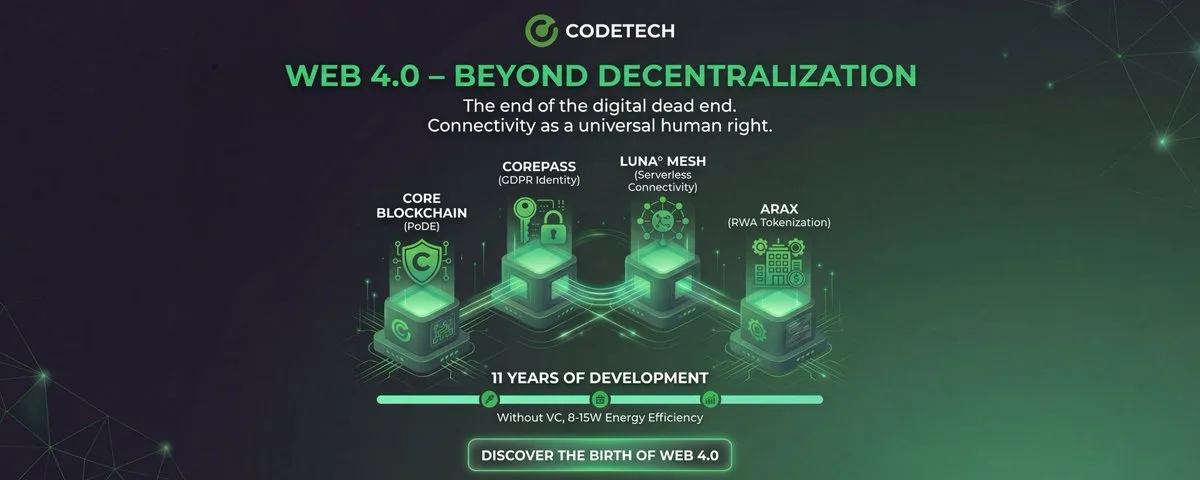
We stand at a critical turning point in digital evolution. While the Internet of Information (Web 2.0) revolutionized our communication, the Internet of Value (Web 3.0) promised liberation from central authorities through decentralization.
But looking behind the facade of recent years, it becomes clear: Web 3.0 has often trapped itself in a dead-end of speculation, enormous energy consumption, and isolated island solutions.
The fundamental problem with existing blockchain architectures is their lack of real-world utility in the physical world. Many projects fail due to regulatory hurdles or dependence on infrastructure that simply doesn't exist in large parts of the world.
This is where the CoDeTech ecosystem steps in with the vision of Web 4.0.
Web 4.0: The Paradigm Shift
Web 4.0 is not just an incremental improvement; it's a paradigm shift. It describes the seamless fusion of:
- Blockchain Technology
- Artificial Intelligence (AI)
- Internet of Things (IoT)
- Decentralized Physical Infrastructure Networks (DePIN)
While Web 3.0 viewed decentralization in isolation, Web 4.0 integrates this technology directly into our physical reality — from intelligent street lamps in smart cities to digital product passports for industrial goods.
The web evolution at a glance:
- Web 2.0 — Centralized: information (Google, Facebook)
- Web 3.0 — Decentralized: ownership & tokenization (Ethereum, DeFi)
- Web 4.0 — Integrated: physical utility, AI & DePIN (CoDeTech, Lunaº Mesh, ARAX)
Through the "Blockchain-as-a-Platform" (BaaP) model, blockchain becomes an invisible yet indispensable operating system for global value chains. It's the transformation of raw data into strategic assets that are tamper-proof, transparent, and verifiable at all times.
The Philosophy: Connectivity as a Universal Human Right
The heart of the CoDeTech evolution is not a technical metric, but an ethical conviction:
Connectivity is a human right.
In a world where economic participation occurs almost exclusively digitally, exclusion from stable networks is equivalent to exclusion from global prosperity.
The problem with traditional providers
Traditional internet service providers focus primarily on Return on Investment (ROI). A transmission tower costing around one million dollars is only erected where a solvent user base justifies the costs. This leaves "digital deserts" in rural areas and disadvantaged economies.
The CoDeTech solution
The CoDeTech philosophy breaks this model:
- Equality through inclusion — the ecosystem is designed to integrate disadvantaged economies into the active global economy.
- Decentralized physical infrastructure — through technologies like Lunaº Mesh, connectivity becomes possible without costly towers. Every IoT device can become a node, enabling access to communication and financial services even where there was previously radio silence.
- Sustainable empowerment — with mining devices consuming only 8 to 15 watts, people in underserved areas can participate in the network and create economic value with minimal resources.
The founders' vision is to provide technology that isn't dictated from above, but grows organically where it's most urgently needed.
The Four Pillars of the Revolution
To understand the scope of Web 4.0, one must examine the four technological pillars supporting the CoDeTech ecosystem:
1. Core Blockchain — The Indestructible Foundation
As a Layer-1 network, it forms the base. Thanks to the proprietary PoDE consensus mechanism (Proof of Distributed Efficiency), it's not only secure but extremely energy-efficient. While other networks require power plants, this one needs only 8 to 15 watts — the power of an LED bulb.
2. CorePass — The Sovereign Identity
CorePass is the gateway to the ecosystem — the world's first fully GDPR-compliant, decentralized digital identity. Control over personal data sits with the user, not the platform: identity theft and corporate data monopolies are designed out, not patched over.
3. Lunaº Mesh — Boundless Connectivity
A serverless mesh network that enables communication and transactions without traditional internet. By utilizing various frequencies, Lunaº Mesh creates a "last-mile solution" that connects even the most remote corners of the earth.
4. ARAX BaaP — The Enterprise Engine
ARAX functions as a "Blockchain-as-a-Platform" provider. It's the bridge to the traditional economy. Here, real-world assets (RWA) are tokenized and business processes are automated through intelligent smart contracts — a "digital SAP for the blockchain era".
Thirteen Years in Stealth: The Story Behind the Code
Most crypto projects today emerge in a few months, driven by quick venture capital and marketing hype. The CoDeTech story is the exact opposite.
Independence through passion
Behind the ecosystem stands a team of visionaries — Michael, Rastislav, and Ockert — who were already active in the blockchain sector long before Ethereum gained popularity. Their path was marked by a conscious decision: no venture capital.
For over thirteen years, development was completely self-funded. This independence was the key to perfecting the Web 4.0 vision without external pressure.
Rethought from the ground up
Instead of copying (or "forking") existing code, the team spent over a decade developing every protocol, every consensus mechanism, and every encryption from scratch. The founders often worked 18 to 20 hours a day to create an architecture capable of handling the massive demands of the future — millions of transactions with minimal energy consumption.
CoDeTech is not the result of a whitepaper seeking investors; it's the result of more than thirteen years of hard work on a functional, finished system.
"We're not building the blockchain for a coin, but for what I call a 'sexy immutable ledger' — an unchangeable ledger that can digitize anything of value."
— Ockert Loubser
Conclusion
If connectivity truly is a human right, the question is simple: how does the economy change when every person on the planet can participate in decentralized finance and data systems without barriers?
That's what Web4 — and CoDeTech — is built for. Not another Web 3.0 token layer, but the infrastructure underneath: payments without a card network, identity owned by you, systems that run without permission.
The difference from most of crypto isn't the pitch. It's that it's already built.