
Deep dive
Not Chips, but Power: How CODETECH Targets AI’s Real Bottleneck
At Davos, Elon Musk names electrical power as the new bottleneck for AI. While the world obsesses over models, chips, and robots, one crucial layer is missing: coordination between power plants, grids, capital markets, and end users. This is exactly where the CORE ecosystem by CoDeTech comes in – with DePIN, tokenization, and smart-city infrastructure.
Energy Is the New “Blockspace” of the AI Economy
On stage at Davos, Elon Musk does something unusual: he talks far less about parameters, benchmarks, and model sizes – and a lot more about power. “I think the limiting factor for AI deployment is fundamentally electrical power,” he says. “It’s clear that we’re very soon—maybe even later this year—we’ll be producing more chips than we can turn on.”
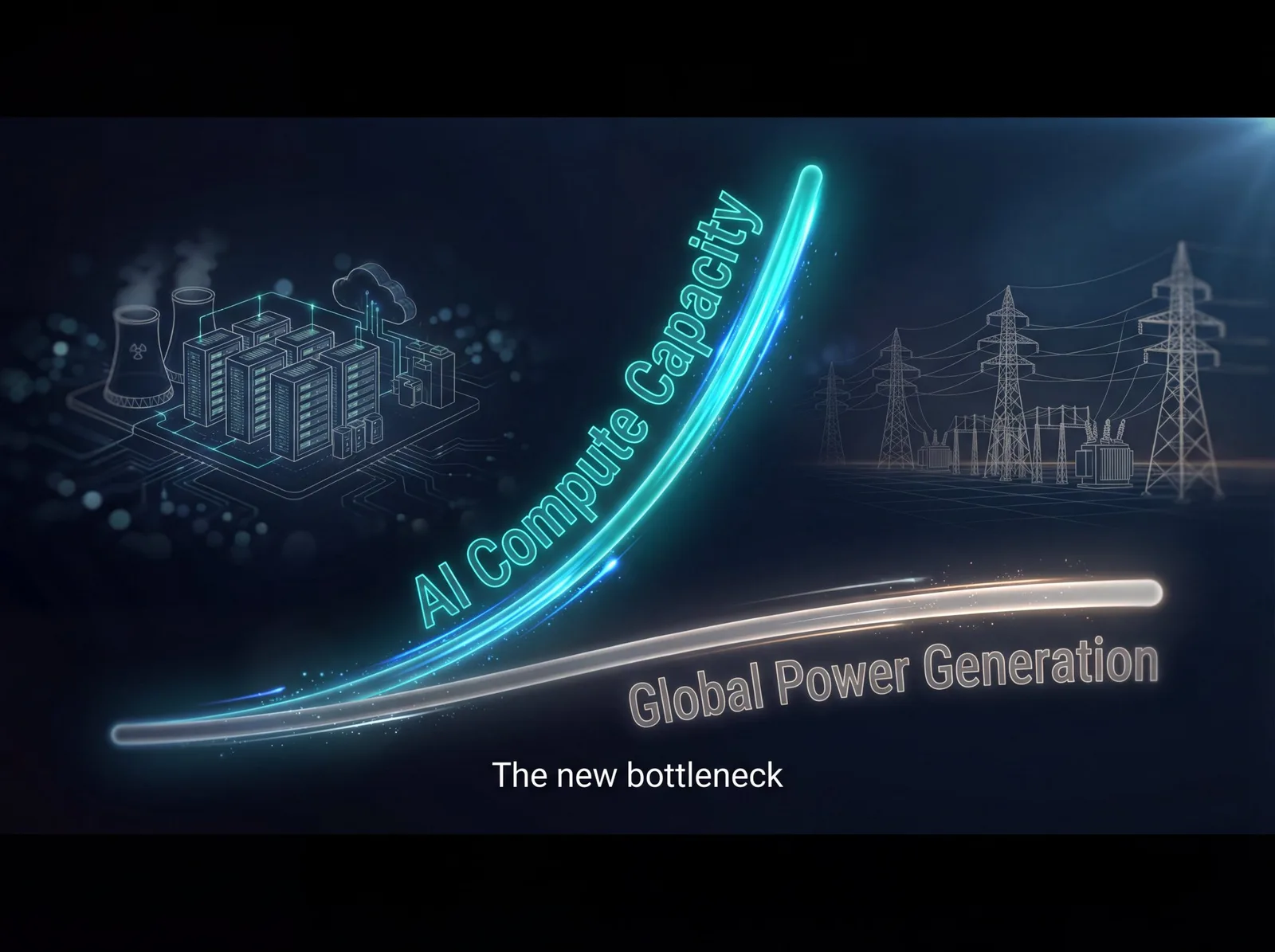
His core diagnosis: AI chips are scaling exponentially, but global power generation is only growing by about 3–4% per year. This turns electrical power into the true bottleneck of the next economic phase – no longer compute, but available gigawatts.
In the same breath, Musk sketches a future that sounds like science fiction yet comes with dates attached: “We might have AI that is smarter than any human by the end of this year or no later than next year. And probably by 2030 or 2031, AI will be smarter than all of humanity collectively.” Add billions of humanoid robots and an AI‑driven economy that will trigger “an explosion in the global economy.”
When it comes to energy, Musk uses deliberately memorable imagery:
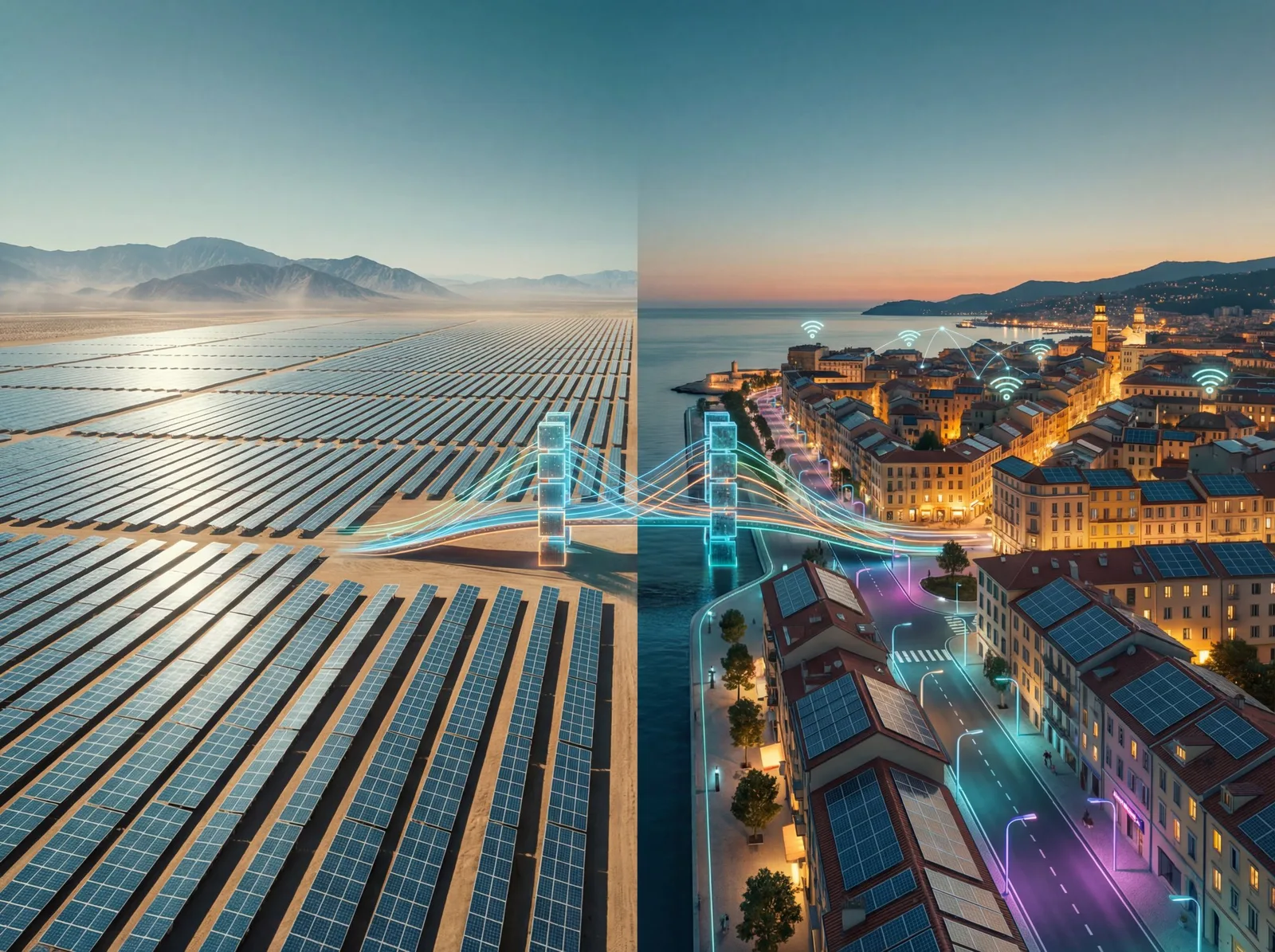
- A patch of “100 miles by 100 miles” of solar – roughly 160 × 160 kilometers – would be enough to power the entire United States.
- He claims that largely unpopulated areas of Spain and Sicily could generate all the electricity Europe needs.[x]
At the same time, he points to political and economic hurdles: “Unfortunately, the tariff barriers for solar are extremely high and that makes the economics of deploying solar artificially high” in the US – while China is rapidly expanding cheap solar capacity.
Musk thus frames energy as a strategic power resource of the AI economy: Whoever controls the cheapest, most scalable power – on Earth or in space – controls the next layer of value creation.
What is barely discussed at Davos: this energy problem is not just physical, it is also digital. The missing piece is an infrastructure layer that connects real‑world assets, grids, regulation, data, and capital in a way that turns energy into a programmable, transparent, and tradable good.
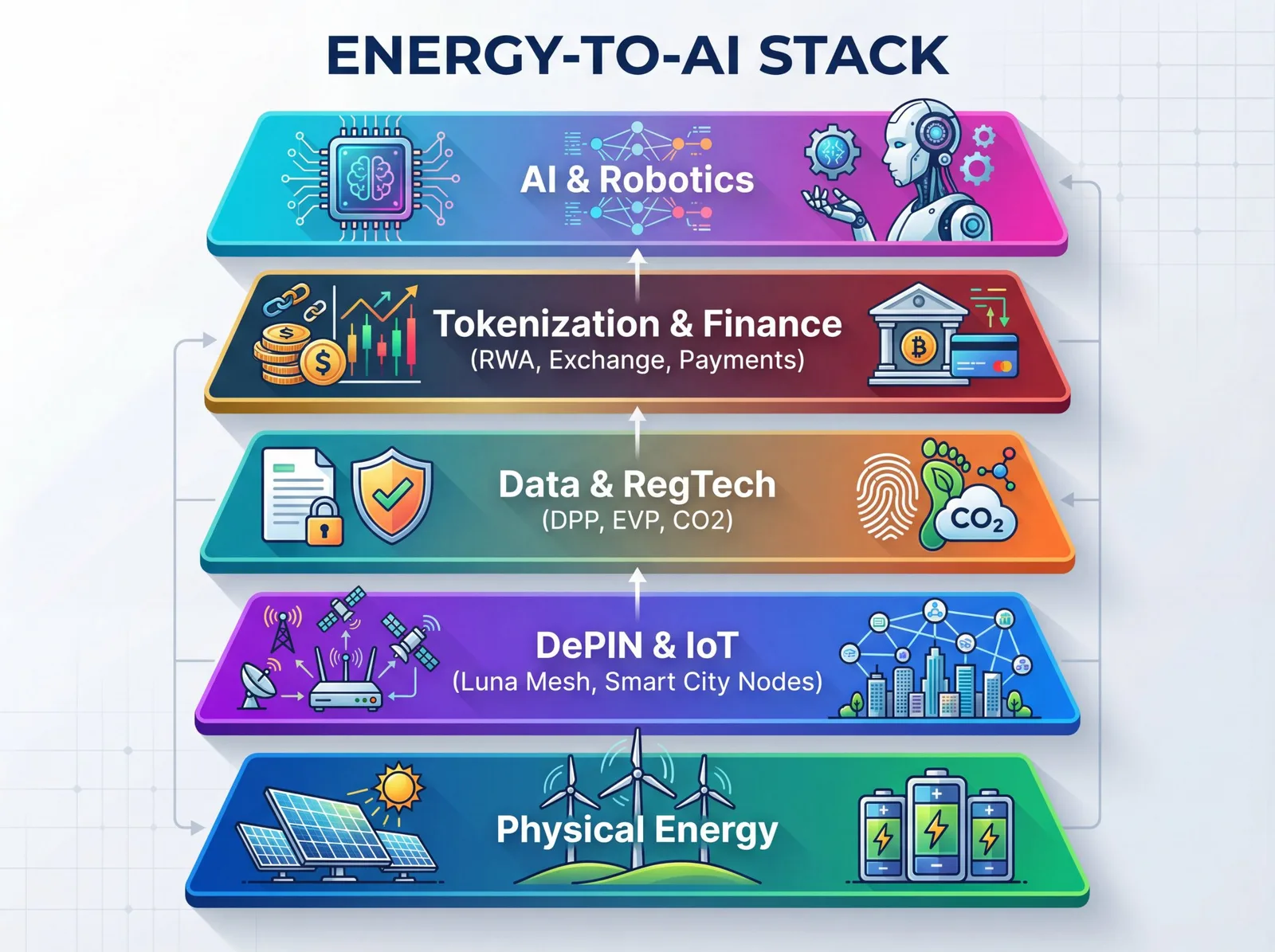
For Web3 natives, the pattern feels familiar: In crypto, the debate has long been about blockspace, gas fees, and throughput – how much “transaction work” a network can digest per unit of time. For AI, the same debate is shifting to the physical world: the limiting factor is no longer only compute blockspace in GPU clusters, but energy blockspace in grids, power plants, storage, and transmission lines.
If we take Musk’s diagnosis seriously, we need a kind of “protocol layer for real‑world energy infrastructure”:
- Sensor networks and DePIN to capture physical assets.
- Digital identities and product passports to make data trustworthy.
- Tokenization to make capacities and cashflows tradable.
- Programmable payments to couple energy flows with capital flows.
This is precisely where the Core ecosystem by CoDeTech positions itself: as a bridge between the physical energy/grid world and the on‑chain AI economy.
Tuzla: From Streetlight to DePIN Node
A concrete example of what this protocol layer looks like in practice is the smart‑city project in Tuzla (Romania). ARAX and the municipality are building a DePIN‑based platform there – starting with intelligent streetlights.
Each streetlight becomes a Lunaº Mesh base node:
- Vertical wind turbines, solar panels, hybrid inverters and battery storage, plus a backup grid connection as the physical energy base.
- A communications layer with mesh connectivity via WiFi, LPWAN, and 60 GHz microwave backhaul that links sensors, meters, and IoT devices in a self‑healing network.
- A data & logic layer built on ARAX BaaP and Core Blockchain that processes real‑time data for energy optimization, monitoring, and smart‑contract automation.
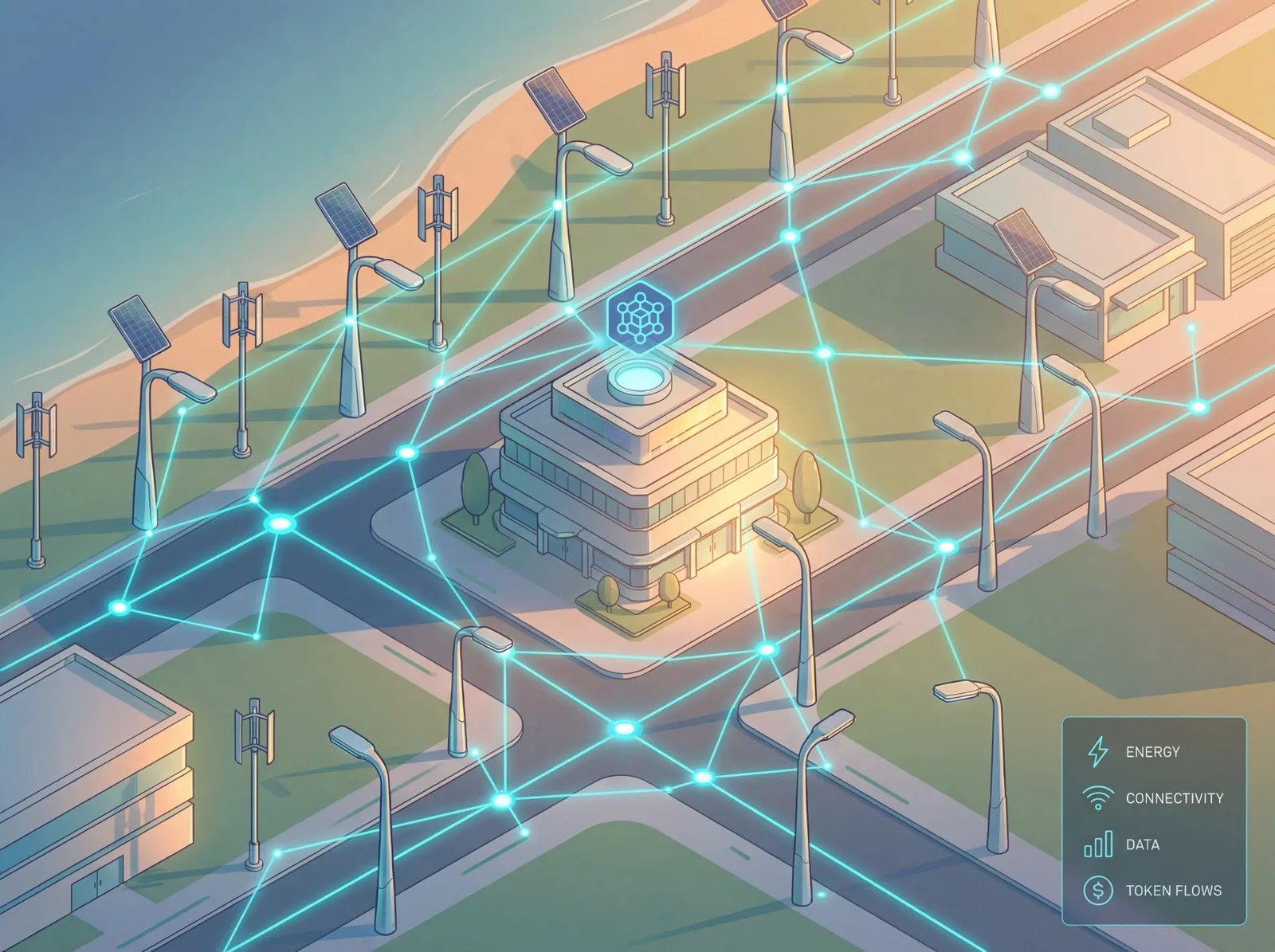
The goal: a scalable model for smart, energy‑efficient, connected urban management. The architecture is designed to add further applications on top of this network – from smart parking and waste management to public WiFi zones and distributed storage.
Tuzla is not a slide in a pitch deck, but a real proof‑of‑concept for what Musk only hints at in Davos:
- Decentralized physical infrastructure (DePIN) that combines renewable energy, connectivity, and compute.
- A full stack from hardware on the lamp post through the mesh network all the way to blockchain‑based settlement.
While Davos debates AI satellites, Tuzla already has physical DePIN nodes hanging from street poles that combine energy, data, and network capacity in a single system.
Core Smart City: Energy as a Core Use Case
Beyond Tuzla, the Core Smart City platform defines a generic approach: it collects and analyzes large volumes of data from sensors, wearables, and IoT devices distributed across city and region via Lunaº Mesh.
The main focus areas include:
- Waste‑to‑energy optimization and renewable energy applications where live energy data feeds business intelligence and operational control.
- Smart‑grid functions where meter readings, load profiles, and grid access are recorded and settled on‑chain – forming the basis for P2P energy trading and dynamic tariffs.
This makes one thing clear: for CoDeTech, energy is not “just another use case” – it is a core vertical where DePIN, IoT, and blockchain fuse into a smart‑city operating system.
EVP, DPP & Carbon Credits: When Data Becomes Currency
At the same time, Europe is rolling out a new wave of regulation: Euro 7, the Ecodesign for Sustainable Products Regulation (ESPR), and the Digital Product Passport require granular sustainability and CO₂ data across the entire lifecycle of products and vehicles.
ARAX addresses this with several building blocks:
- Environmental Vehicle Passport (EVP): a blockchain‑based cradle‑to‑grave data space for vehicles that supports Euro 7 compliance and CO₂ monitoring.
- Digital Product Passport (DPP): a data container for products that holds material provenance, ESG data, repair/recycling information, and CO₂ footprint – embedded into Core standards.
- Carbon credit tokenization: emissions rights mapped to Core Blockchain and tied to DePIN/IoT data to reduce double‑counting and greenwashing.
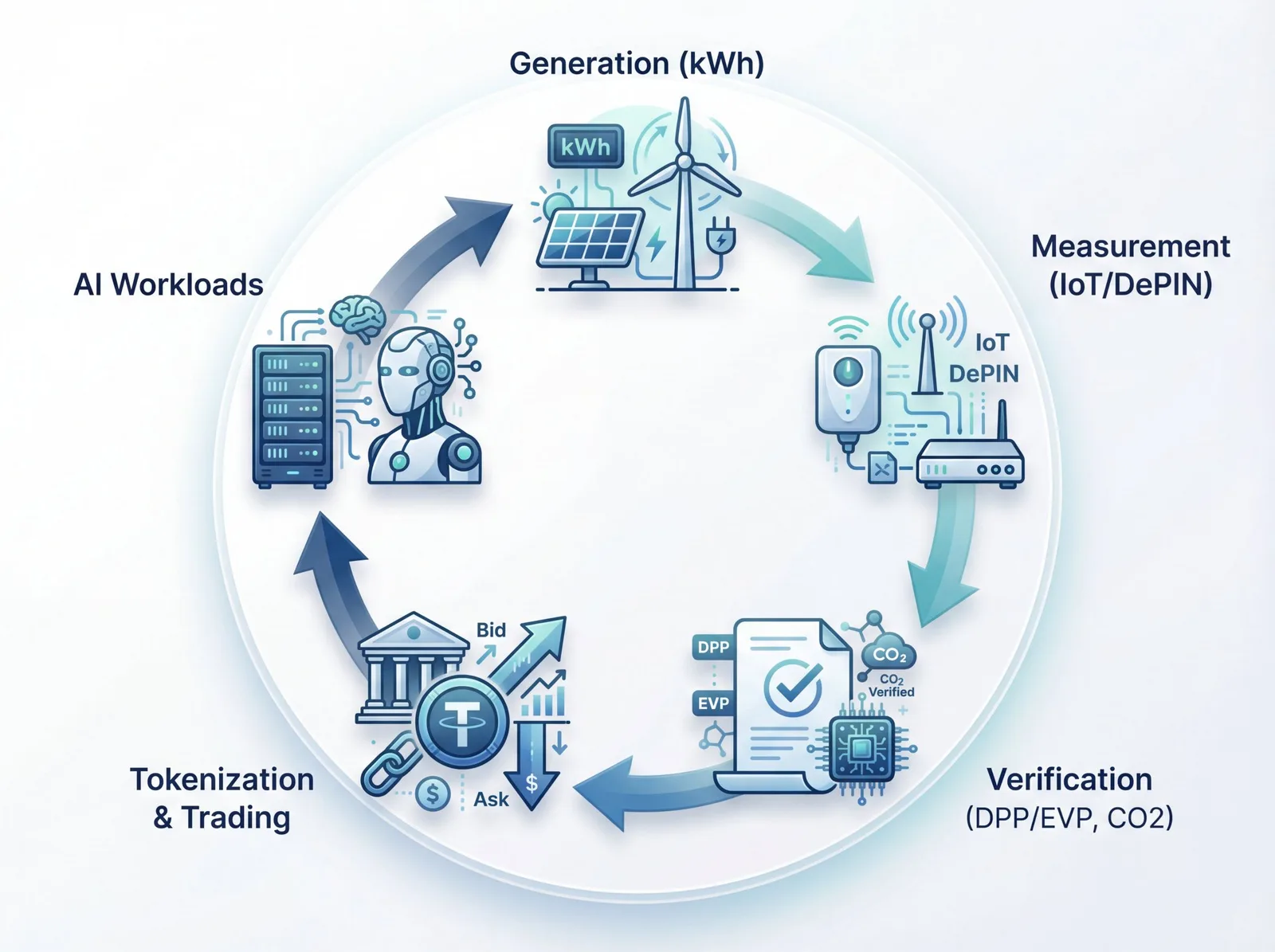
As a result, energy, emissions, and lifecycle data become:
- auditable,
- regulator‑ready,
- and tradable.
This is the precondition for turning “AI power” itself into an asset class that can be managed on‑chain – including CO₂ profiles and compliance proofs.
Finance & Settlement: From Energy RWAs to Cash Flows
On the financial side, the CoDeTech stack already offers a largely complete RWA and payments infrastructure:
- Core Tokenizer & CBC standards: Tokenization of real‑world assets as CBC20 (fungible), CBC721 (unique), or CBC1155 (fractional), including freeze/burn/redeem logic. Use cases range from commodities through vehicle parts and consulting hours to carbon credits and, prospectively, energy capacities.
- Ping Digital Commodities Exchange: Lists tokenized commodities and RWAs, offering spot, forwards, RFQs, and delivery‑versus‑payment (T+0). Redemption and burn on physical delivery provide a real bridge between tokens and goods.
- PayTo, MoneyX, Wall Money: PayTo: programmable cross‑asset payments for token transfers, invoicing logic, splits, and subscriptions. MoneyX: multi‑currency stable tokens with an FX engine for hundreds of currency pairs, fully integrable via API/SDK. Wall Money: a multi‑asset neobank with wallets for fiat, crypto, and tokenized commodities, card on/off‑ramp, and settlement engine.
This means that – unlike many “energy‑blockchain” pitches – there is already a complete path in place:
- An energy asset is created (e.g., kW capacity of a solar park, a CO₂ credit, or an AI compute hour at a DePIN node).
- This asset is tokenized under a CBC standard and enriched with DPP/EVP metadata.
- It is traded on Ping, settled via PayTo/MoneyX, and ultimately reaches an investor’s card or bank account through Wall Money.
In Musk’s language: “AI power” and energy capacities become on‑chain‑defined capacity rights that can be slotted into AI or energy portfolios like any other asset class.
From Musk’s AI Satellites to a Tokenized Energy City
Musk’s Davos narrative can be read as a roadmap across three layers:
- Musk layer: In 5–10 years, AI models run at scale on solar‑powered satellites in orbit. Humanoid robots perform most physical work. Energy is the strategic resource that determines who can operate such a system.
- Europe layer: At the same time, European projects struggle with permitting, financing, and public acceptance, even though land, technology, and capital are largely available. The “100 × 100 miles” solar patch looks trivial in physics terms – but is economically and politically complex as long as data, cashflows, and governance sit in separate silos.
- CoDeTech layer: Projects like Tuzla demonstrate what a DePIN node looks like in reality: a combination of renewable energy, mesh connectivity, edge compute, storage, and a blockchain backbone. With DPP/EVP, carbon tokenization, and CorePass identity, the data from this infrastructure becomes regulator‑ready – from Euro 7 and ESG reporting all the way to AML/KYC. With Core Tokenizer, Ping Exchange, PayTo, MoneyX, and Wall Money, a physical project turns into an on‑chain investable asset that can be co‑funded by retail investors, municipalities, utilities, and institutions.

This creates the counter‑image to Musk’s “100 × 100 miles of solar in the desert”:
- Many smaller, interconnected, tokenized infrastructure clusters in cities, towns, and industrial zones.
- Each cluster can support both classical energy use cases (power, heat, mobility) and AI/edge compute workloads – and monetize its capacities via the same blockchain stack.
In doing so, CoDeTech answers a question that at Davos is only asked between the lines:
Who will build the coupled energy backbone for an AI world?
The answer: DePIN networks like Luna Mesh, smart‑city stacks like ARAX BaaP + Core Blockchain, and token/payment infrastructure that bring energy, data, and money onto a common rail.
Implications for Policy, Industry, and Investors
- Policy & regulators: Energy and grid infrastructure should be treated as programmable, tokenizable public assets – with DPP/EVP, DePIN, and DAO‑like mechanisms as tools for transparency and citizen participation.
- Energy, utilities, and infrastructure players: Projects that today fail due to CAPEX constraints, reporting overhead, or lengthy permitting can be executed in smaller, iterative clusters via RWA financing, automated data pipelines, and smart contracts. DePIN platforms like Luna Mesh allow existing infrastructure (poles, buildings, lamps, meters) to be upgraded instead of replaced.
- Investors: “AI exposure” is no longer just a bet on model providers and GPU manufacturers – it also includes energy, DePIN, and smart‑city infrastructure whose output is delivered as digital, auditable tokens.
If Musk is right and energy becomes the real currency of the AI era, then networks like Luna Mesh and platforms like CoDeTech are the translation layer: they turn megawatts and megabits into on‑chain rights, yields, and responsibilities.