
Op-ed
Invisible in the crypto hype: how influencers and AI hide CORE

We explain why CORE barely shows up in today’s crypto discourse – and why that has far more to do with influencer economics and AI filters than with any lack of substance.
1. Introduction: Visibility in an attention market
In today’s crypto economy, visibility is rarely decided by the technical quality of a project, but by the business model of those talking about it. Most crypto influencers do not primarily earn money from long‑term, successful investments, but from affiliate deals, courses and paid placements – from attention, not from skin in the game.
There are credible exceptions – for example editorial formats like CryptoSlate – but the dominant mechanism is simple: attention over substance. In this logic, projects like Core are structurally pushed to the margins: complex, regulation‑oriented, deeply infrastructural, and impossible to compress into “10x in 10 days” clips or simple referral funnels.
At the same time, AI‑driven research tools amplify this invisibility because they keep surfacing whatever is already loud and popular. Our core claim: CORE is not ignored because it would be irrelevant, but because it does not fit the economic and algorithmic logic of the current influencer market – even though this is exactly the layer where connectivity, identity and compliance for real people are being built.
2. What crypto influencers actually sell
On the surface, many crypto influencers share the same story: early into Bitcoin, Ethereum or the “right” altcoin, now financially free, generously “giving back” to their community. If you follow the money, a different picture emerges.
2.1 Affiliate programs
Exchanges, brokers and crypto tools pay for every new user and every transaction driven through specific links. Once placed, referral links create recurring income – regardless of whether followers make a profit or lose money.
2.2 Courses, academies and coaching
From entry‑level webinars to high‑ticket mentoring, promises of “knowledge” are packaged as products. In practice, funnel performance – click‑through rates, conversions, upsells – often matters more than pedagogical depth.
2.3 Sponsored content
Projects and platforms can literally buy their way into content as a “hidden gem”, “top play of 20XX” or “massive upside coin”. Risks, conflicts of interest and compensation details, if mentioned at all, tend to live in the fine print.
Analyses of finance and crypto influencers show that these monetisation channels often sit at the centre, while the quality of recommendations is secondary. An international study on finfluencers found that investors would have been better off doing the opposite of more than half of their recommendations – and especially worrying, the worst advice frequently came from the largest accounts.
The consequence is clear: communities are treated primarily as revenue pools, not as partners in a shared learning process.

2.4 A positive counterexample: CryptoSlate & Akiba
CryptoSlate demonstrates that there is another way – a news and data platform that relies on actual journalism instead of shill mechanics.
Liam “ Akiba ” Wright, through the SlateCast podcast, has held in‑depth conversations with CoDeTech CEO Ockert Loubser on the future of blockchain, Web3 failures (cloud centralisation, token fetish) and CORE as an infrastructure‑first answer to these problems. In his “Core Corner” column he analyses Core Blockchain (XCB), CorePass ID and Ping Exchange Exchange technically and economically, including decisions like Ping’s pure P2P orderbook model without market makers.
CryptoSlate also covers concrete use cases such as life‑settlement structures moving onto Core, and how Ping’s hybrid custody and CorePass‑based login model rethinks exchange security. This is the kind of treatment we wish more players would adopt: deep, critical, use‑case oriented – not just chasing the next price spike.
3. Why real knowledge transfer is rarely the goal
If we take this business model seriously, it becomes obvious why genuine education is often seen as a nuisance. Anyone who sells the story “I am the expert” has little incentive to create formats that expose their own limits.
Critically examining this, three patterns stand out:
- Critical discussion threatens the expert narrative. Detailed questions about identity models, custody, settlement architecture or regulation require substance – or they expose that the persona is built on theatrics rather than depth.
- Real understanding makes followers independent. The more people truly grasp the basics, the less they need signals, “insider tips” and expensive shortcuts – and the less attractive they are as customers for courses, signal groups and fee‑laden platforms.
- Dialogue does not scale like broadcast. Algorithms reward short, polarising messages and clear winner/loser narratives, not nuanced debates in comment threads.
Research on opinion leaders in crypto on X shows that a small number of accounts dominate the conversation and mostly operate in broadcast mode, not dialogue. Topics that require explanation and nuance – like infrastructure and regulation – almost automatically get sidelined.
CORE, by design, lives on exactly that “slow” layer of the stack.
4. Why CORE is invisible in this logic
The CORE ecosystem by CoDeTech is, in many ways, the opposite of a classic hype play.
- Layer‑1 infrastructure: Core Blockchain is an independent, energy‑efficient PoW network with its Proof of Distributed Efficiency (PoDE) concept, optimised for CPUs and IoT hardware instead of giant mining farms.
- Digital identity: CorePass is a decentralised, GDPR‑compliant ID platform that turns official documents and attributes into verifiable credentials, with fine‑grained user control over data sharing.
- Hybrid exchange: Ping Exchange is a regulatory‑ready trading venue built around CorePass‑based KYC/AML, hybrid cold‑storage custody and delivery‑versus‑payment (DvP) flows inspired by traditional finance and commodities markets.
- DePIN & mesh: Luna Mesh is a network for last‑mile connectivity and resilient communication that can move data even without stable internet, targeting IoT and critical‑infrastructure scenarios.
- RegTech & tokenisation: Core‑based tools aim at settlement, supervisory connectivity and real‑world asset tokenisation – from life settlements to digital product passports.
None of this fits on a simple “Buy now” button. It is about architecture, governance, compliance and real‑world usage.
From an influencer‑economics perspective, three things make CORE hard to monetise as content:
- no aggressive retail affiliate campaigns,
- use cases instead of meme stories,
- a narrative of “working infrastructure for real markets” rather than “next 100x coin”.
For a creator who lives off short‑term trading hype and referral flows, this is an awkward package: too complex, not speculative enough, too far away from the familiar “signal in, trade out” mechanic.
The fact that many “crypto experts” simply have nothing to say about CORE is therefore less a judgement on the project and more a symptom of their own incentives.
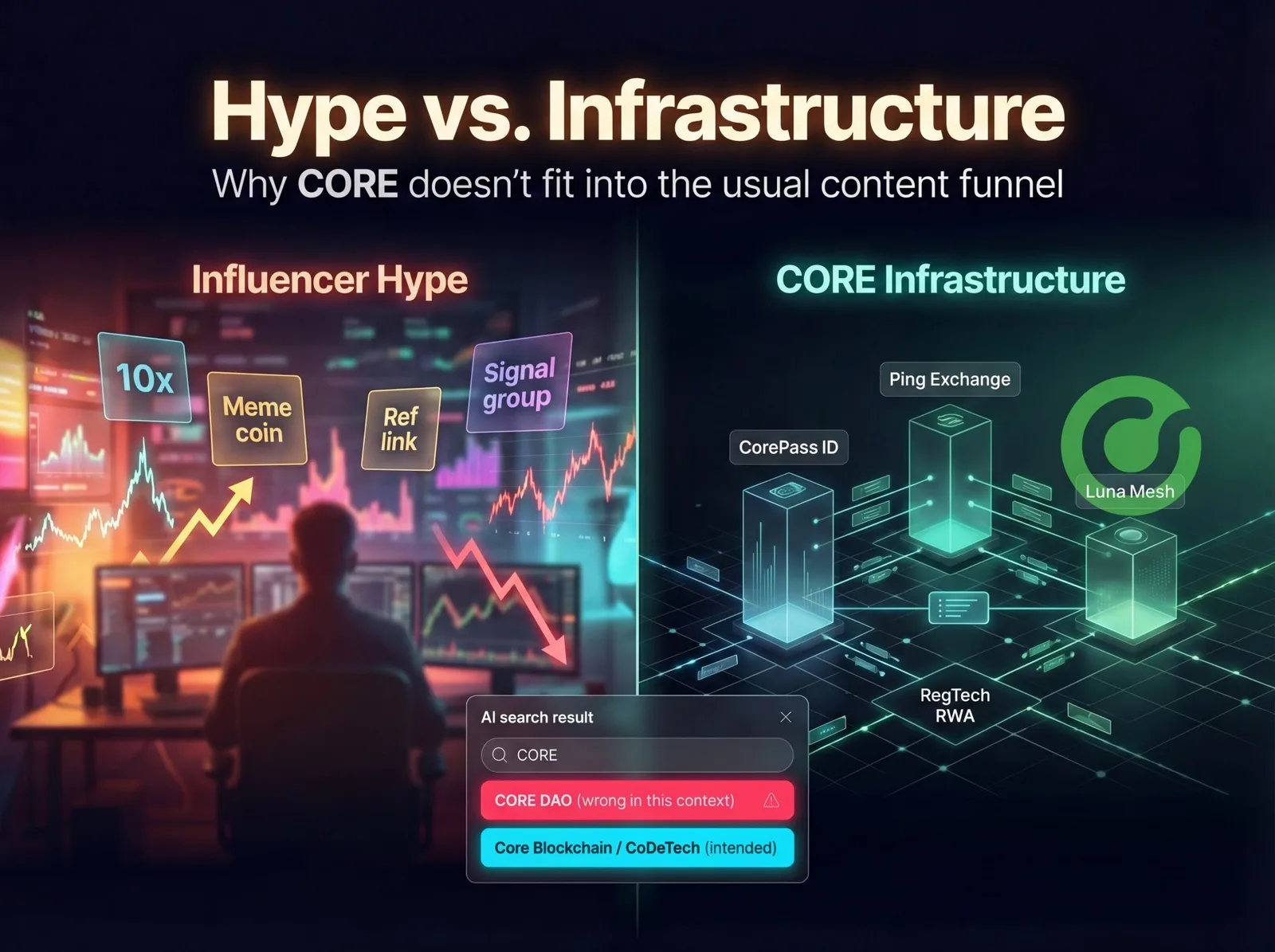
5. AI as amplifier – and CORE vs. CORE DAO
At the same time, AI tools are becoming central to research and content production. Many creators now rely on language models to draft summaries, scripts and even opinions, based on whatever is already indexed on the web.
These systems:
- treat topic frequency – number of articles, searches, mentions – as a proxy for relevance, elevating Bitcoin, Ethereum, dominant L1s, big exchanges, scandals and meme coins again and again,
- reproduce visibility rather than discovering under‑documented projects.
For CORE there is a specific additional issue: many general‑purpose AI systems consistently confuse CORE with CORE DAO and its “Core Chain”.
Projects, tokens, technical attributes and narratives get mixed up, to the point where even seemingly knowledgeable actors publish content clearly referring to our ecosystem, but label it as “CORE DAO” because their AI‑assisted research led them there.
For anyone leaning heavily on such tools, CORE then appears blurry, inconsistent or “not properly documented”.
The result is a double blind spot:
- The business model offers little incentive to dig into complex infrastructure.
- The tools used to “research” that infrastructure are biased or outright wrong.
Anyone who lets this combination of monetisation logic and AI filter guide their perspective will almost inevitably miss CORE – regardless of how relevant the underlying technology is.
6. How we respond – two complementary routes
With “TELL ME MORE ABOUT CORE” we consciously chose a different path.
6.1 Podcast: space for context
Our first response to the ecosystem’s complexity was the podcast format. What started as short explanatory episodes quickly evolved into long‑form conversations, because each layer – blockchain, identity, exchange, mesh, RegTech, RWA – immediately triggers new questions.
Instead of chopping everything into shallow snippets, we give topics room: background, cross‑references, critical questions, corrections. Precisely the kind of depth that simply does not fit into shorts and reels.
6.2 X: explanation and friction
On X (Twitter) we deliberately use two different voices
- The project account focuses on explanatory threads, comparisons, diagrams and contextual posts for people approaching from the outside.
- A private account operates more confrontationally inside existing communities, openly naming weaknesses of centralised exchanges, identity‑less wallet models or pseudo‑decentralised structures – and presenting CORE as a counter‑model.
This way we combine education and disruption: we provide material for those who genuinely want to understand, and create friction where comfortable narratives go unchallenged.
6.3 Blog: structure and reuse
Blog articles add a third layer: structured texts that can serve as reference, onboarding material or even input for AI systems.
Our goal is that anyone with basic crypto literacy can build a coherent picture of CORE in a reasonable amount of time – without having to reconstruct years of forum posts and internal calls. At the same time, these texts are dense enough to act as credible sources for other content producers and analysis tools.
7. Another building block – for outsiders and machines
From this experience we derive three requirements for future content:
- reduce complexity without distorting the substance,
- create entry points for people outside the CORE community – entrepreneurs, regulators, developers, influencers,
- structure information so that humans and AI systems can process it reliably.
In short: podcast for depth, X for dialogue and friction, articles for structure and reusability.
8. “Connectivity is a human right” – more than a slogan
For us, connectivity is not a lifestyle upgrade, but a prerequisite for participation: without secure communication, digital identity and financial infrastructure, people are effectively excluded from the digital economy.
“Connectivity is a human right” is therefore not a marketing line but a design principle.
8.1 PoDE and IoT mining
Core uses Proof of Distributed Efficiency (PoDE), a consensus mechanism designed to run on low‑power hardware – from mini PCs to specialised IoT devices.
The goals:
- include regions with expensive electricity and weak infrastructure,
- think decentralisation in hardware as well as software,
- turn mining into a tool for local development instead of centralised extraction.
8.2 Luna Mesh: connectivity beyond the internet
Luna Mesh extends this into the physical network layer: a decentralised mesh that can route data locally – offline, online, hybrid.
It is built for last‑mile connectivity, rural areas, mining regions, crisis scenarios and protected networks. Mechanisms like epidemic routing allow data to be buffered locally and synced once a node with external connectivity comes back online.
8.3 CorePass: identity as part of connectivity
CorePass links connectivity to identity. The platform supports the digitisation of official documents and attributes, a granular permission model and logins/transactions through cryptographic approvals instead of passwords.
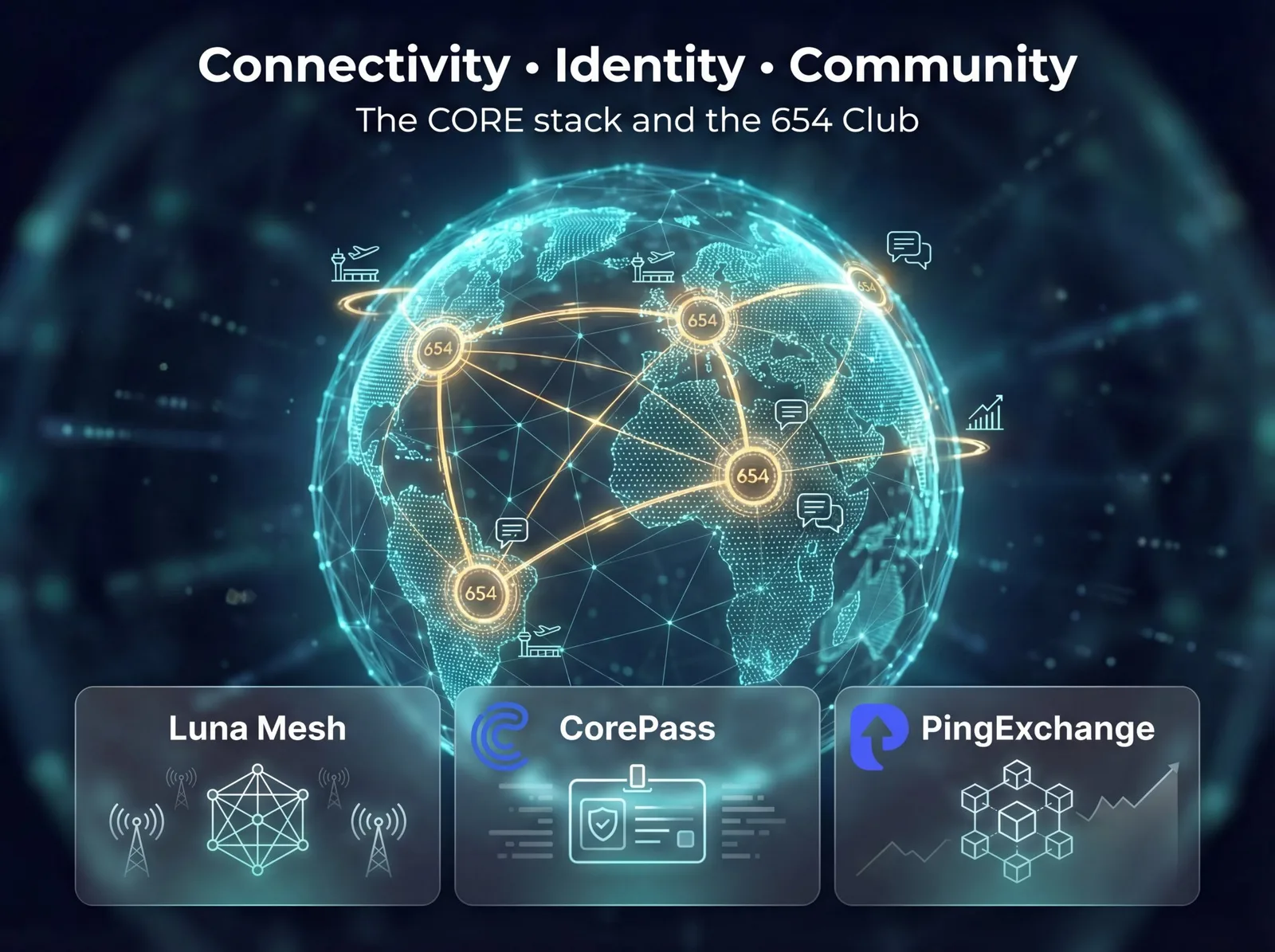
Together, Luna Mesh (connectivity), CorePass (identity) and Core / Ping (settlement and trading) form a stack that is particularly relevant where traditional internet and banking infrastructure is missing or politically restricted.
8.4 The 654 Club: long‑term community
The 654 Club is a concrete expression of this philosophy: a community tied less to short‑term price targets and more to infrastructure, responsibility and real‑world usage.
The idea goes beyond online chats – it includes international meetups, local gatherings around CORE‑based applications and even spontaneous encounters, for example when two people recognise 654 branding in the same airport lounge.
The focus is not “who is shilling which coin to whom”, but recognising each other as people working on the same fundamentals: connectivity, identity, participation.
8.5 A deliberate contrast to the influencer economy
This creates a clear contrast:
- when we say “community”, we mean networks oriented towards long‑term usage and shared values, not just funnels for referral links,
- when we say “connectivity is a human right”, we mean technology should be built so that as many people as possible can use it, not only the most profitable target segments.
In that sense, CORE is less a speculation vehicle and more a deliberate decision for access and infrastructure.
9. How real stance will show over time
As CORE gains visibility, it will become obvious who starts talking about it, when and how.
For us, CryptoSlate is an example of early, substantive engagement: Akiba has gone beyond marketing statements and tackled concrete questions of architecture and use cases in interviews and columns. We actively seek out this type of actor – regardless of whether their final verdict is purely positive or critically nuanced.
Those who only show up once price action, hype or big partnerships cross a certain threshold simply confirm the pattern we described: visibility follows opportunity, not substance.
We have decided not to smooth over this difference, but to make it visible – by explaining influencer logics, inviting open discussion on X, in the podcast and in written form, and by creating content that makes a genuine understanding of CORE possible in the first place.
In an environment where many communities are primarily treated as revenue sources, we deliberately focus on an ecosystem that puts connectivity, identity and participation at the centre – even if that means staying invisible for a while longer.
If the only projects you ever hear about are the ones that fit neatly into an influencer funnel or an AI‑generated list, you are not seeing the crypto space – you are seeing a curated storefront. CORE was never built for the storefront. It was built for the backbone: for connectivity, identity and real‑world settlement where no meme coin will ever show up.
Whether that remains invisible or becomes impossible to ignore will not be decided by algorithms or affiliate links, but by the people who choose to look behind the hype – and then stay to help build what they find.