
Essay
CONNECTIVITY IS A HUMAN RIGHT
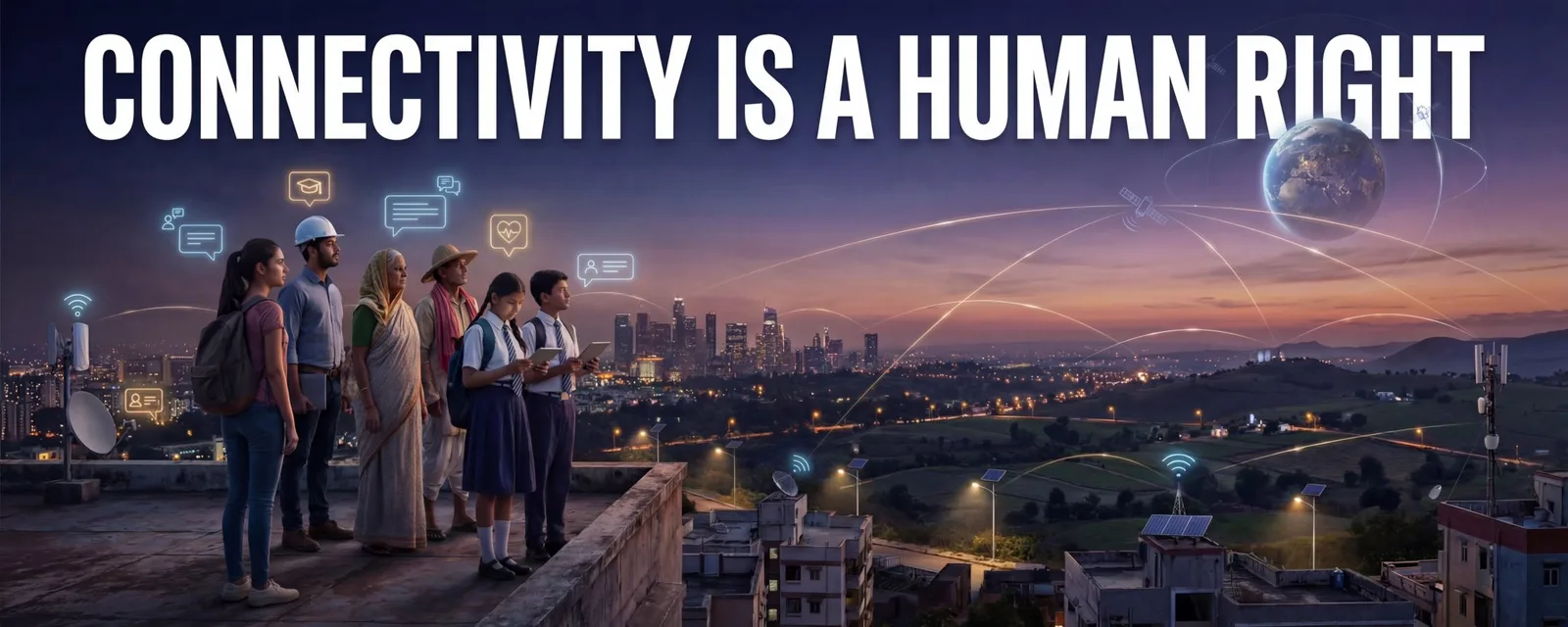
How Decentralized Infrastructure Turns a Slogan into Reality
1. From Slogan to Survival Question
“Connectivity is a human right” sounds, at first, like an idealistic slogan for conferences, banners, or social media posts. But as our world becomes more digital, it turns into a sober systems question:
- Who has access to knowledge – in a time where AI delivers in seconds what once required libraries?
- Who can participate in digital markets – in an economy where remote work, e‑commerce, and DeFi are normal?
- Who can prove their identity, rights, and property digitally – and who is practically non‑existent online?
In a world where education, work, money, government, and communication are mediated by networks, connectivity determines whether someone is part of society – or stuck at the margins. The phrase “Connectivity is a human right” is therefore not a marketing line, but the expression of a simple truth:
Without access to the network, all classical human rights get hollowed out in practice.
The old school system still pretends the classroom is the center of education – but today, the true center is the network connection.
2. Why Connectivity Is a Human Right
2.1 Education 2.0: Knowledge Exists – But Not for Everyone
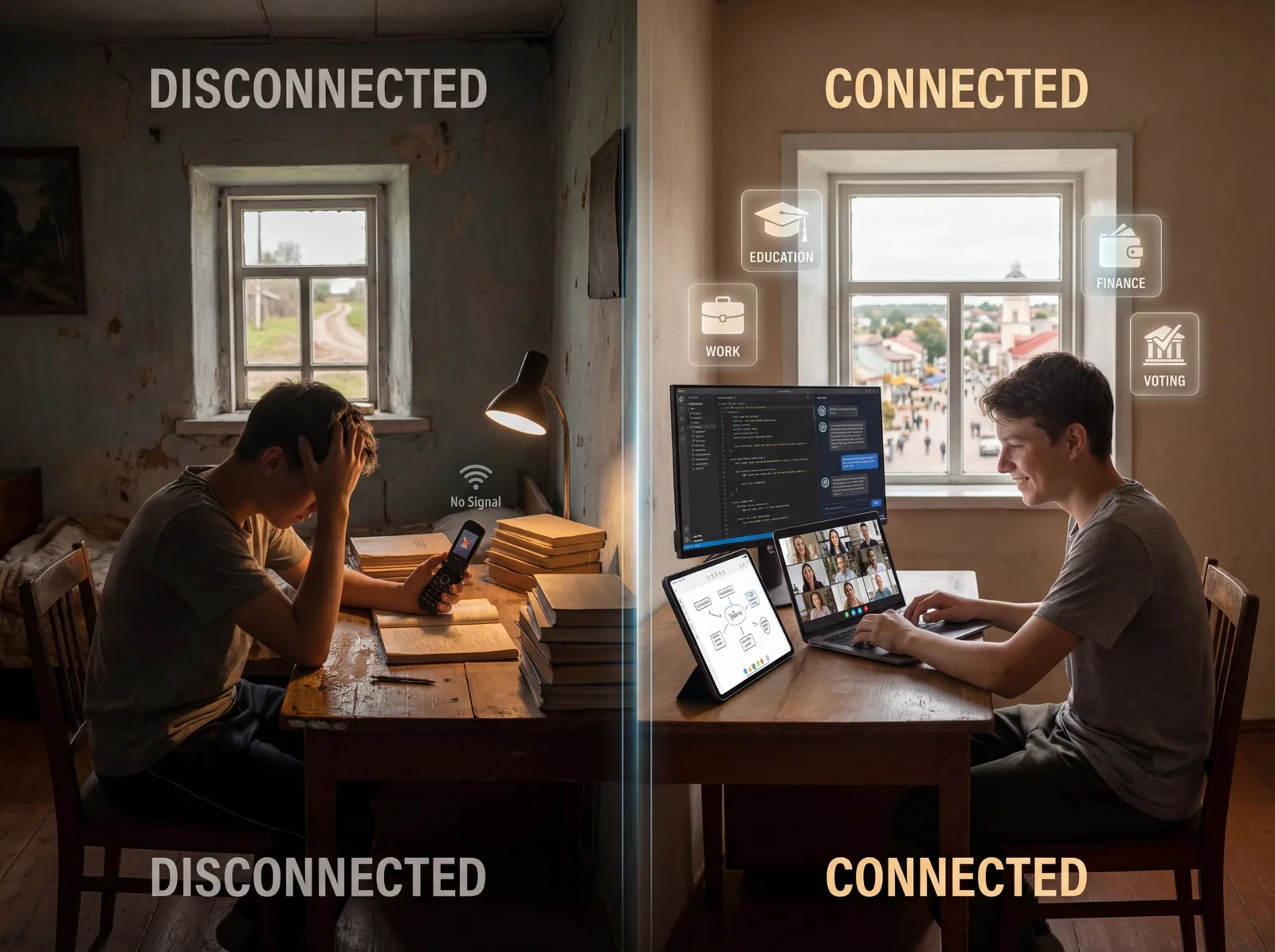
Artificial intelligence can now explain, translate, code, visualize, write, correct, and teach in a personalized way. All of this rests on one silent precondition: access.
Without stable connectivity, people:
- cannot use modern learning platforms,
- cannot tap into freely available courses and open‑source knowledge,
- are excluded from collaborative projects, remote mentoring, and global communities.
The result: Even where school buildings exist, modern education remains a luxury where there is no connectivity – not a right for everyone.
2.2 Economic Participation: Markets Have Gone Digital
Labor markets, commerce, services, and financial systems have deeply digitized:
- Freelancing platforms, remote jobs, global project work,
- online commerce and platform economies,
- digital payments, stablecoins, DeFi, tokenized assets.
If you’re offline, you simply cannot access these channels – no matter how talented, motivated, or hard‑working you are. Connectivity becomes a prerequisite for economic self‑determination.
2.3 Political and Social Participation
E‑government, digital citizen participation, access to information, activism, and community organizing all increasingly take place online. Without net access, people:
- know less,
- are heard less,
- can shape less.
The more digital democracies become, the clearer it gets:
Without connectivity, there is no equal participation.
3. Why Legacy Infrastructure Models Fail
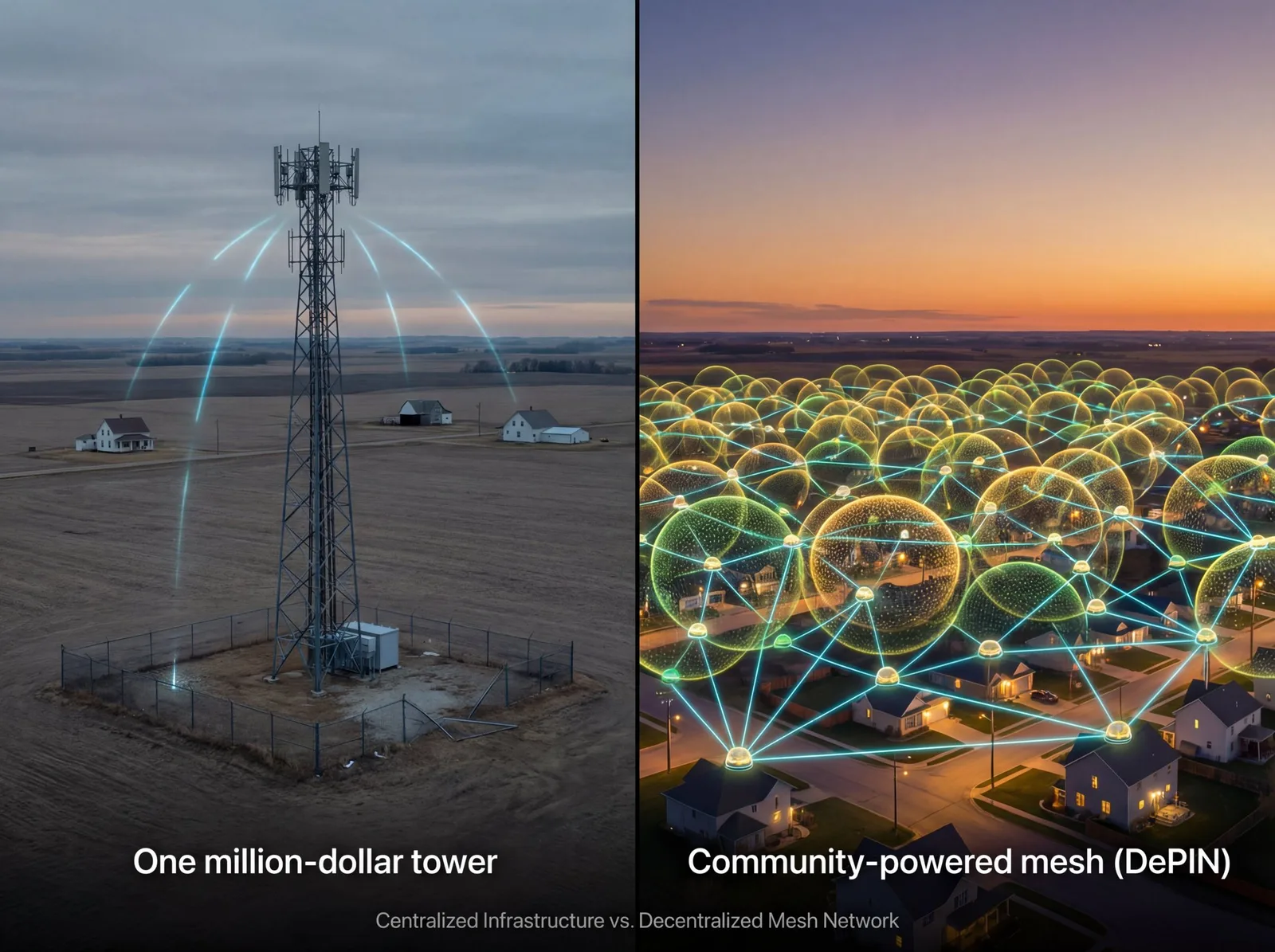
3.1 The One Tower That Costs a Million
Traditional telecom models rely on expensive, centralized infrastructure: cell towers, fiber backbones, centralized data centers. A professional tower can easily end up in the seven‑figure range; operators invest only where the return on investment is obvious.
The consequences:
- rural regions, poorer areas, and politically unstable countries remain under‑served,
- “uneconomic” people – too few or not rich enough – stay offline.
3.2 Centralized Networks: Fragile, Censorable, Expensive
Centralized networks have structural weaknesses:
- Single points of failure: when a core node or backbone goes down, communication collapses across large regions.
- Controllability: states or corporations can cut access, filter content, or switch off entire regions.
- Cost structure: the infra is optimized for billing, not for inclusion.
If connectivity is to be treated as a human right, humanity cannot afford a model where economic profitability outweighs access itself.
4. Thinking Decentralized: What CoDeTech/Core Does Differently
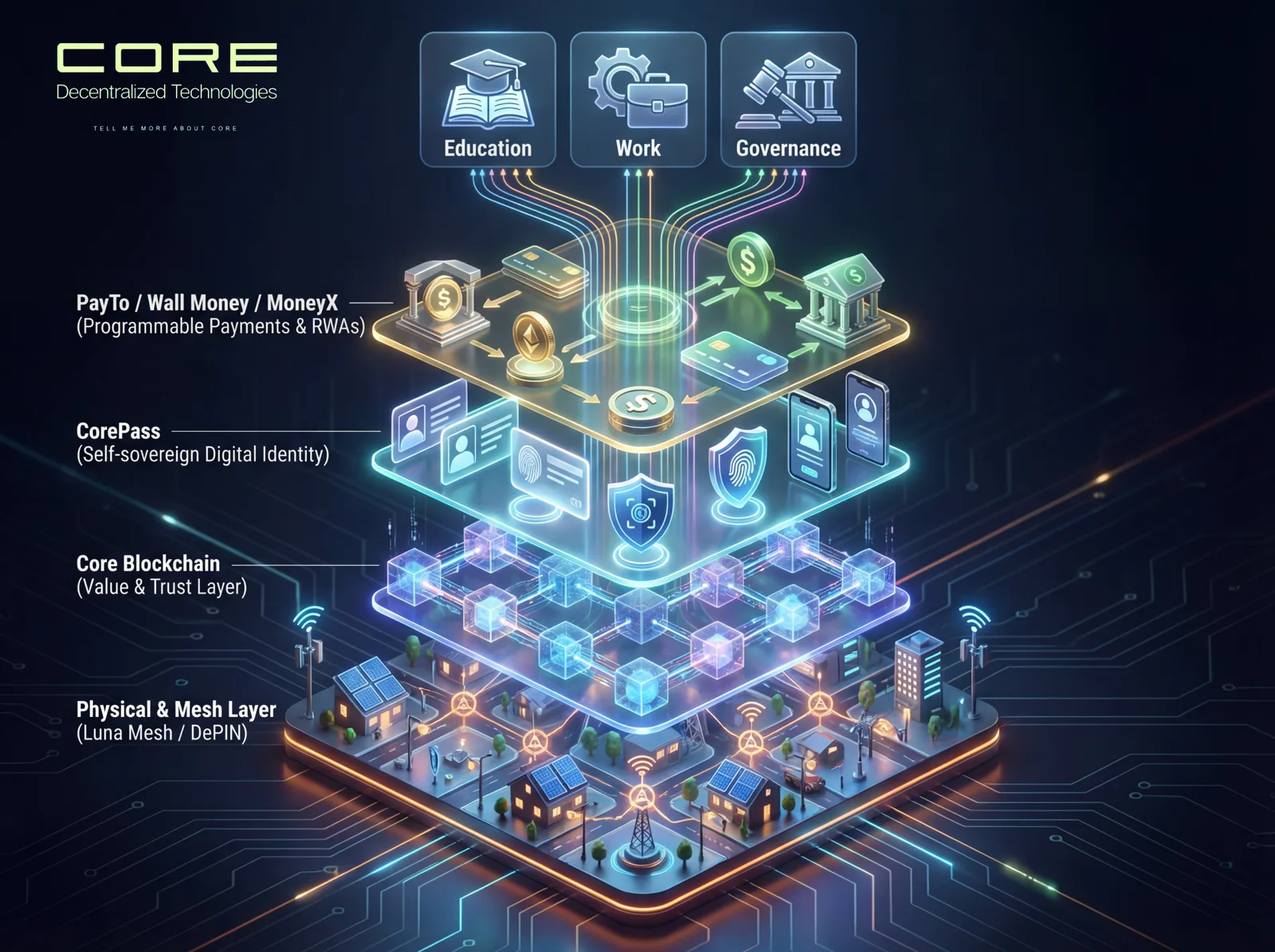
CoDeTech (Core Decentralized Technologies), ARAX, and the Core ecosystem tackle exactly this: they build decentralized infrastructure to enable connectivity, identity, and value transfer even where legacy models fail.
4.1 Core Blockchain: Value and Trust Layer
The Core blockchain is a Layer‑1 network with its own currency (XCB), designed for decentralization, efficiency, and real‑world use cases. Key properties:
- Proof of Distributed Efficiency (PoDE): an energy‑efficient consensus mechanism that allows mining on small, low‑cost IoT devices.
- These devices need only about 8–15 watts, so they can run in resource‑constrained regions.
- Fast finality: block times around 7 seconds; transactions reach finality in well under a minute.
- Open participation: CPU and IoT mining mean the network isn’t limited to large data centers; communities, businesses, and individuals can run nodes and miners themselves.
Core thus becomes the open, decentralized settlement layer for identity, payments, data‑hashing, and DePIN applications.
4.2 Luna Mesh: The Network When There Is No Network
Lunaº Mesh is a decentralized, borderless mesh networking topology where nodes connect directly, dynamically, and non‑hierarchically to move encrypted, blockchain‑anchored data.
Principles:
- No central node; messages hop from node to node until they reach their destination.
- Uses existing and new IoT devices (Raspberry Pi, smart meters, custom nodes) as mesh nodes.
- Supports multiple bands and modes – from sub‑GHz to WiFi ranges and satellite backhaul.
- Offline capability and “epidemic routing”: data can be buffered locally, synchronized later, and verified via blockchain hashes – without putting raw data on‑chain (GDPR‑friendly).
In practice, Luna Mesh enables:
- Last‑mile connectivity for ISPs and communities without building expensive towers.
- Community networks – for example in mining areas in Africa, enabling communication across several kilometers without relying on classical telco infrastructure.
- Crisis and special operations: search and rescue, disaster response, military comms, and smart‑city sensing.
In short: Luna Mesh is what a cell tower would be if it belonged to the community, not just to ROI spreadsheets.
4.3 CorePass: Self‑Sovereign Digital Identity
Connectivity alone is not enough. To participate digitally, people need trustworthy yet privacy‑preserving identity.
CorePass is a peer‑to‑peer, GDPR‑compliant digital identity and attribute platform:
- It digitizes government‑issued documents and links them to a verified digital identity (Core ID).
- Data is not stored centrally, but encrypted inside the user’s wallet; sharing is selective and permissioned.
- It supports KYC, AML, CFT, PEP checks via partners, making it usable in regulated environments.
- It doubles as a cold wallet and multi‑chain wallet (e.g. Bitcoin, Ethereum, Litecoin, Solana, XCB).
This allows a rare balance:
- verified identity for governments, financial institutions, and platforms,
- with maximum data sovereignty for users.
Especially if we treat connectivity as a human right, it is crucial that digital identity does not become a gateway to surveillance, but a tool for self‑determined participation.
4.4 DePIN & Payments: When Infrastructure Pays for Itself
A network that treats connectivity as a right needs a sustainable economic model.
- DePIN incentives: operators of mesh nodes, storage nodes, or sensors can be rewarded via token economies (e.g. CTN/XCB) for providing infrastructure. This creates circular models where communities build and operate infra instead of merely being “customers”.
- PayTo protocol: a programmable payments protocol that ties together identity (CorePass), accounts (ICAN – International Crypto Account Number), and cross‑asset flows – e.g. send in BTC, receive in EUR stable, with compliance baked in.
- Wall Money & MoneyX: Wall Money: a multi‑asset neo‑banking interface combining self‑custody wallet, cards, stable tokens, and global on/off‑ramps. MoneyX: an FX stable layer with digital representations of many fiat currencies and audit tools for transparency.
The result is a tightly coupled fabric of connectivity, identity, and value – where those who provide infrastructure share in the upside.
5. Rethinking Education: From Classroom to Network
Education is arguably the clearest test case for “Connectivity is a human right”.
Most school systems are still optimized for industrial‑age logic:
- mandatory in‑person attendance in a classroom,
- teacher‑centric lecturing,
- standardized curricula,
- exams that reward reproduction rather than understanding.
At the same time, we live in a world where:
- knowledge is available on demand in seconds,
- AI can generate, explain, visualize, and teach content in a personalized way,
- projects, communities, and learning groups operate globally and asynchronously.
The bottleneck has shifted:
- away from “Do you have access to information?”
- towards “Do you have access to networks, tools, mentors, and markets?”
Future skills are:
- critical thinking instead of rote memorization,
- creativity instead of rigid templates,
- self‑directed learning instead of blind curriculum obedience,
- literacy in AI, data, and money.

All of this presupposes stable, free connectivity – not just in privileged cities, but also in rural regions and underserved communities.
As long as connectivity is a privilege, “new education”, EdTech platforms, AI‑tutor models, and virtual classrooms are mostly solutions for those who already start with a head‑start.
Only when connectivity becomes as taken for granted as clean water or electricity can self‑directed, free education become a realistic right for everyone.
6. Responsibility & Governance: Who Protects This Right?
If we treat connectivity as a human right, we must ask: Who guarantees it? States, corporations, communities, DAOs?
The architecture of the Core ecosystem tries to take this seriously:
- The Core blockchain is governed by a foundation and a decentralized network of nodes and miners – not owned outright by a single company.
- DAO models and community governance are envisioned for token use, DeFi projects, and infra use cases.
- CorePass is designed as an independent identity layer to earn trust from governments, businesses, and citizens without creating centralized data silos.
The underlying insight:
A “right” that can be granted or revoked by a single provider is not a right, it’s a service.

Therefore, infrastructure that underpins connectivity must be:
- open, interoperable, and open‑source,
- operable in a decentralized way,
- governed under plural models where users, communities, and regulators all have a stake.
7. Conclusion: From Vision to Invitation
“Connectivity is a human right” is more than a slogan. It is a design principle for technology, education policy, economic models, and governance.
The building blocks to realize this right in a decentralized, secure, and sustainable way already exist:
- energy‑efficient blockchains like Core that can run on IoT devices,]
- mesh networks like Luna Mesh that provide connectivity without classical towers,
- digital identity systems like CorePass that enable verification without monopolizing control,
- DePIN models that reward communities and businesses for providing physical infrastructure.
The open question is no longer whether we will build a highly connected, AI‑augmented world – that is already underway. The real question is:

For whom?
Will connectivity remain a privilege for those born into the “right” postcode – or will we finally treat it, as the digital reality demands, as what it has already become: a human right.