
Op-ed
Bitcoin, greenwashing and better alternatives: why the energy problem isn’t solved

A recent post claims the “biggest climate lie about Bitcoin” is the idea that it is still an environmental disaster – arguing that more than half of mining already runs on renewables and mainly uses “stranded energy”. The implication: the problem is basically solved, critics are stuck in 2017. That narrative gets an important part right – and still misses the point that matters in 2026.
1. What the post gets right
Let’s start fair.
Several analyses, including updated work from Cambridge and industry research, indicate that a significant share of Bitcoin’s energy mix is now “sustainable” or low‑carbon – with estimates above 50%. The picture has clearly changed compared to the era when most large‑scale mining was tied to coal‑heavy grids in China.
The so‑called “stranded energy” argument is also real: miners do move to locations with cheap, underutilised power:
- isolated hydro plants with surplus generation,
- solar peaks that exceed local grid capacity,
- otherwise flared methane at oil fields.
In these niches, Bitcoin can indeed act as a flexible offtaker that monetises energy that would otherwise be wasted. That is a meaningful improvement over the old image of miners plugging straight into fossil‑heavy grids.
But going from “less bad than before” to “problem solved” is a leap.
2. Relative progress ≠ solved problem
The critical distinction: relative improvement does not erase absolute scale.
Even with a greener mix, Bitcoin’s electricity consumption remains on the order of entire countries. Recent analyses still compare it to mid‑sized economies like Poland in absolute energy use. That magnitude matters, because those same kilowatt‑hours are not abstract: they compete with other urgent uses:

- stabilising increasingly volatile grids as more renewables come online,
- decarbonising energy‑intensive industries,
- electrifying transport and heating at scale.
“Stranded energy” is a subset of reality, not the whole. A non‑trivial portion of mining still takes place in regions where power is scarce or has high opportunity cost, and even where it doesn’t, the global footprint does not disappear just because some part of it sits on underused resources.
In other words: a better energy mix makes Bitcoin less dirty than it was – it does not automatically make it climate‑optimal.
3. Economic logic follows price, not climate
The original post also frames miners as an almost benevolent force that chases unused renewables and enhances their profitability. That is partially true, but the logic behind it is purely economic, not climate‑driven.
Miners are price‑takers:
- When surplus hydro, wind or solar is cheapest, they move there.
- When subsidies or regulatory arbitrage make gas or coal suddenly cheaper, they can move back.
Mining is an opportunistic load, not a climate policy tool. It does not commit to long‑term financing of renewable projects, nor does it guarantee a desirable geographic distribution of capacity. It follows the cheapest marginal kilowatt‑hour in each regulatory and political environment.
That behaviour is rational from a miner’s perspective – but it means:
- no guarantee that today’s “green” locations remain dominant tomorrow,
- no built‑in mechanism aligning mining with long‑term decarbonisation strategies,
- no reason to assume the environmental externalities are fully internalised.
So yes: Bitcoin can sometimes improve the economics of individual renewable assets. It does not automatically become a controlled, reliable instrument of climate policy.
4. We no longer need ASIC farms for security
The deeper question is not whether Bitcoin has become “less bad”, but whether its architecture is still the best available option for achieving its goals, given what we know in 2026.
We now have almost two decades of experience with different consensus mechanisms. It’s clear that:
- strong security and decentralisation are not inherently tied to excessive energy use, and
- many tasks that used to require brute‑force proof‑of‑work can be achieved with more efficient designs.
One example is Proof of Distributed Efficiency (PoDE) as implemented on Core Blockchain. Instead of concentrating hashing power in specialised ASIC farms with industrial‑scale power draws, PoDE is designed to run on:
- regular CPUs,
- low‑power mini‑computers,
- IoT‑class devices.
Typical power budgets are in the single‑digit to low double‑digit watt range per device, not hundreds or thousands of watts per unit. At the same time, Core’s PoDE network targets:
- block times on the order of a few seconds,
- full confirmation and settlement within tens of seconds.

The point is not to advertise one chain, but to highlight a principle: the claim “sound, decentralised security inherently requires energy consumption on the level of nation states” no longer holds up technically. We have real‑world systems that deliver comparable or higher functional value with orders of magnitude less energy.
Insisting that Bitcoin’s energy profile is a fixed cost of “freedom” ignores the fact that the design space has evolved.
5. From “green mining” to measurable decarbonisation
There's another blind spot in the original post: even if we accept that part of Bitcoin’s load uses stranded renewables, that still frames crypto purely as an energy consumer. The more interesting question is: how can blockchain infrastructure actively support decarbonisation?
Here, the conversation shifts from “what powers the nodes?” to “what do we use the network for?” Some of the most promising directions combine:
- blockchain as an immutable, time‑stamped data layer, and
- IoT as a source of real‑world measurements.
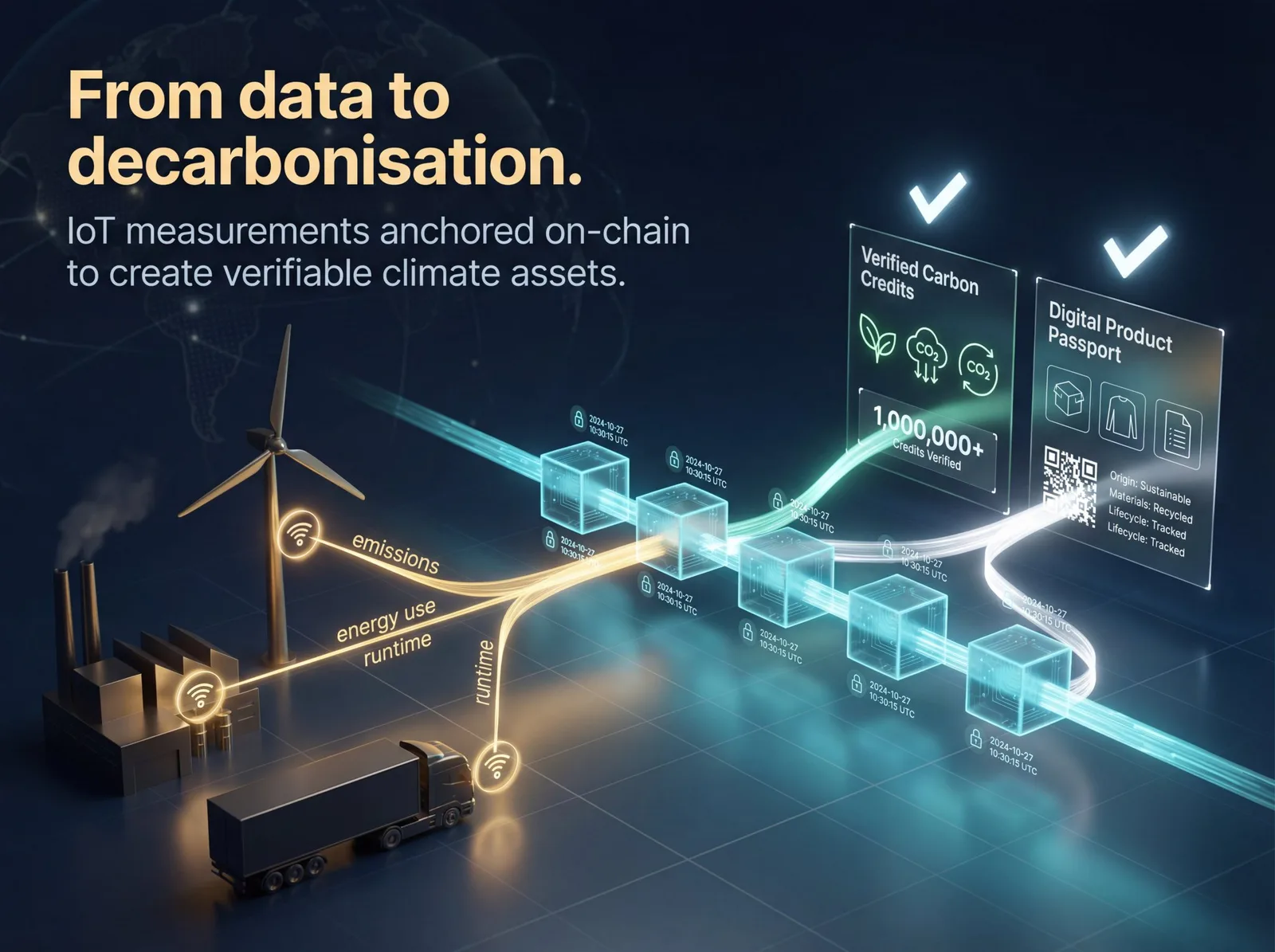
Concrete patterns include:
- IoT sensors on machines, vehicles or industrial equipment measuring real emissions or energy usage,
- on‑chain recording of these data points to prevent retroactive tampering,
- generation of verifiable carbon credits or on‑chain attestations based on audited data,
- digital product passports that carry lifecycle and emissions information for goods.
These architectures address real climate‑policy problems:
- greenwashing (claims without verifiable data),
- double‑counting of emission reductions,
- opacity in voluntary carbon markets and supply chains.
Infrastructure stacks like Core explicitly aim at that intersection: an efficient consensus layer (PoDE), an identity layer (CorePass) and connectivity/DePIN components that together can link physical measurements to regulatory‑quality records and tokenisation.
That is a qualitatively different contribution to climate action than “we monetise surplus megawatts”.
6. The real “climate lie”
So where is the actual “climate lie” in the Bitcoin debate?
It is not true that Bitcoin has stood still. The energy mix has improved, miners increasingly tap into renewables and waste streams, and some legacy criticisms are outdated. Acknowledging that is important if we want a credible discussion.
The problematic narrative is something else: pretending that this incremental progress settles the question – and that the classical Bitcoin mining model is effectively the end state of crypto energy design.
In reality:
- we already have consensus mechanisms that deliver comparable security and functionality with a fraction of the energy use,
- we already have infrastructures that embed climate‑relevant data and identities as first‑class citizens instead of afterthoughts.
- we already have architectures designed to run on low‑power, widely distributed hardware rather than centralised industrial farms.
Against that backdrop, the real half‑truth sounds like this: “Bitcoin used more renewables last year, therefore the environmental discussion is over.”
It isn’t. The more honest framing would be: “Bitcoin’s footprint is less bad than it used to be – but we now know how to design systems that are not just less bad, but structurally better in terms of energy efficiency and climate transparency.”
If the only “evidence” for environmental progress in crypto you ever hear is that Bitcoin’s energy mix has improved, you are seeing a small slice of a much larger evolution. The real question for 2026 and beyond is no longer whether we can justify Bitcoin’s energy use with increasingly clever arguments – but why we should accept old architectures as final, when newer ones can combine security, decentralisation and measurable decarbonisation by design.