
Deep dive
From mining farms to real decentralisation: what CoDeTech does differently
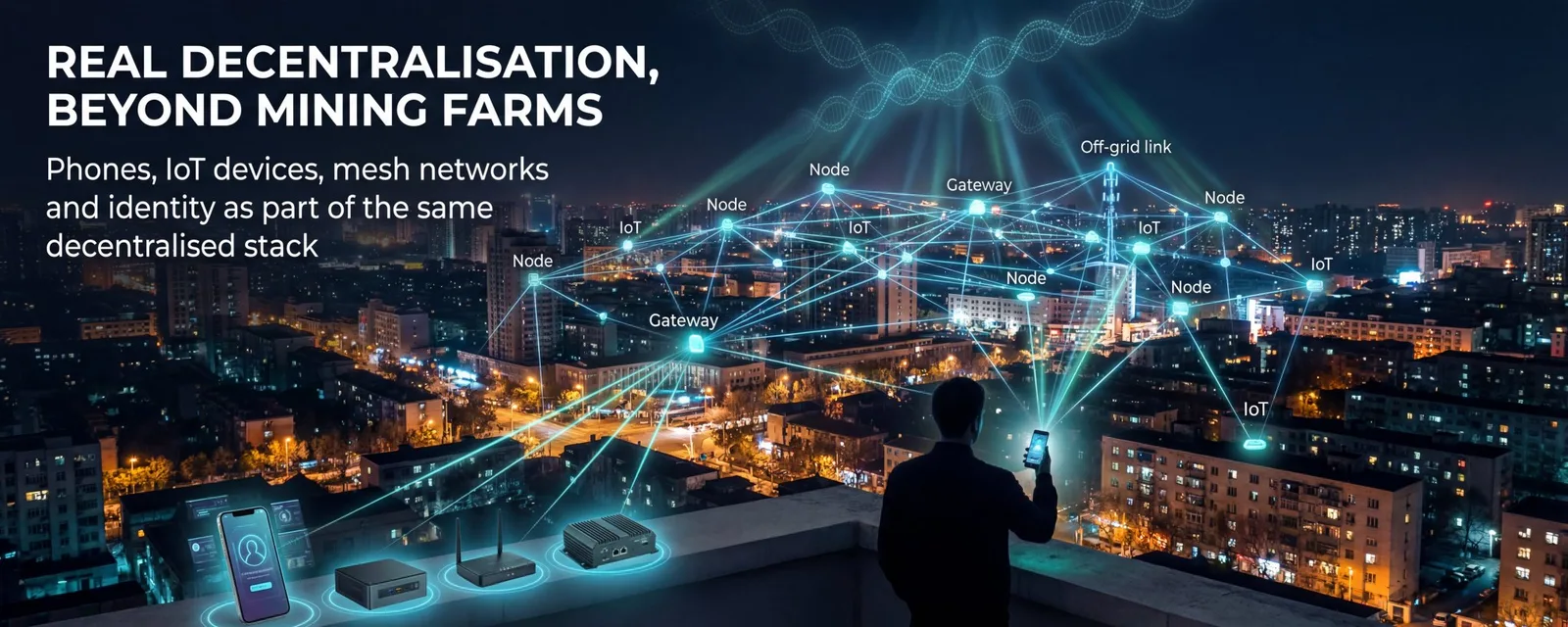
In the last article, we looked at why "Bitcoin is getting greener" does not mean the energy problem is solved. The energy mix has improved, but the architecture remains power‑hungry and highly concentrated. The more interesting question is therefore: what does a blockchain look like that not only uses less electricity, but actually brings decentralisation into everyday life?
This is exactly where the CORE ecosystem by CoDeTech comes in – with a focus on small devices instead of ASIC farms, nodes on smartphones, connectivity without the internet, self‑sovereign identity and the integration of physical infrastructure into the ledger.
1. PoDE: mining on small devices instead of an ASIC oligopoly
Bitcoin started as decentralised money, but in practice has ended up with a few large mining firms that secure cheap locations and power deals. Formally decentralised, in reality highly concentrated.
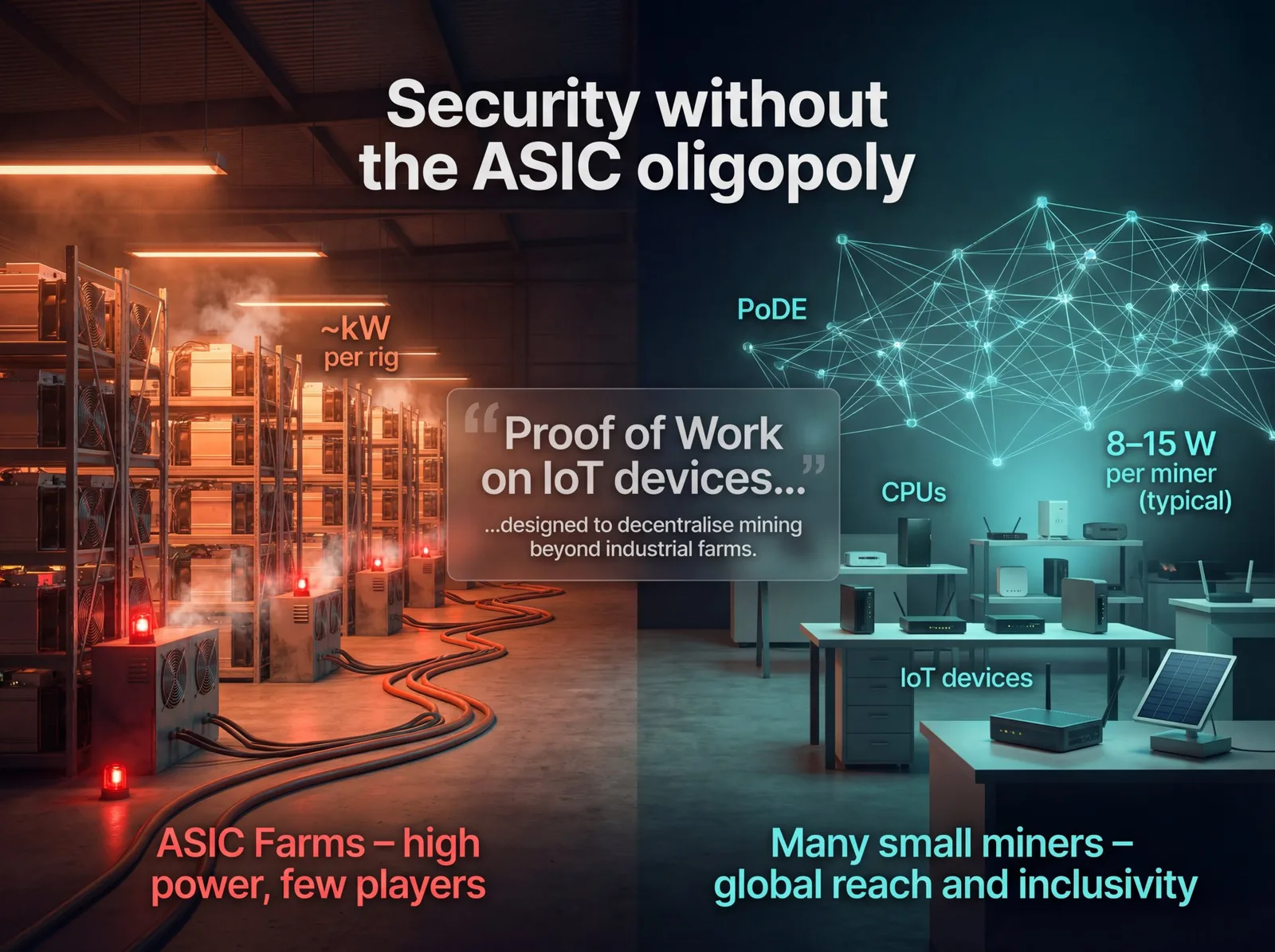
To put this into perspective: a single Bitcoin transaction consumes roughly 1,200 to 1,450 kWh of electricity – enough to power an average US household for over 40 days. The total network draws an estimated 150–175 TWh per year, comparable to the electricity consumption of Argentina or Poland. A single ASIC miner pulls 2,000 to 3,500 watts continuously.
Core Blockchain deliberately takes a different route. The consensus mechanism Proof of Distributed Efficiency (PoDE) is an energy‑efficient proof‑of‑work explicitly optimised for normal CPUs and IoT devices – not for specialised ASIC hardware.
Mining devices operate in the range of just 5 to 15 watts – the power of an LED bulb, not a factory floor. This means mini PCs, routers or IoT nodes can participate, rather than only warehouses full of specialised chips.
CORE thus breaks consciously with the image of the giant farm and aims for hash rate that is broadly distributed across many small participants. Official Foundation material expresses this ambition in a pointed way: "Proof of Work on IOT devices making Core Blockchain the only true decentralized blockchain in the world." You do not have to adopt this superlative to understand what it is aiming at: moving away from the ASIC oligopoly toward a consensus that normal hardware can realistically join.
CoDeTech articulates the target image even more clearly: "Mining with PoDE on small IoT devices to ensure global reach and inclusivity for all communities." Here, decentralisation is explicitly understood as accessibility – not just as an abstract node count, but as the question of who can actually afford to be part of consensus.
2. “Blockbook in your pocket”: nodes and explorer on your phone
For CORE, decentralisation does not stop at mining. It continues in the infrastructure that makes the chain readable and usable.
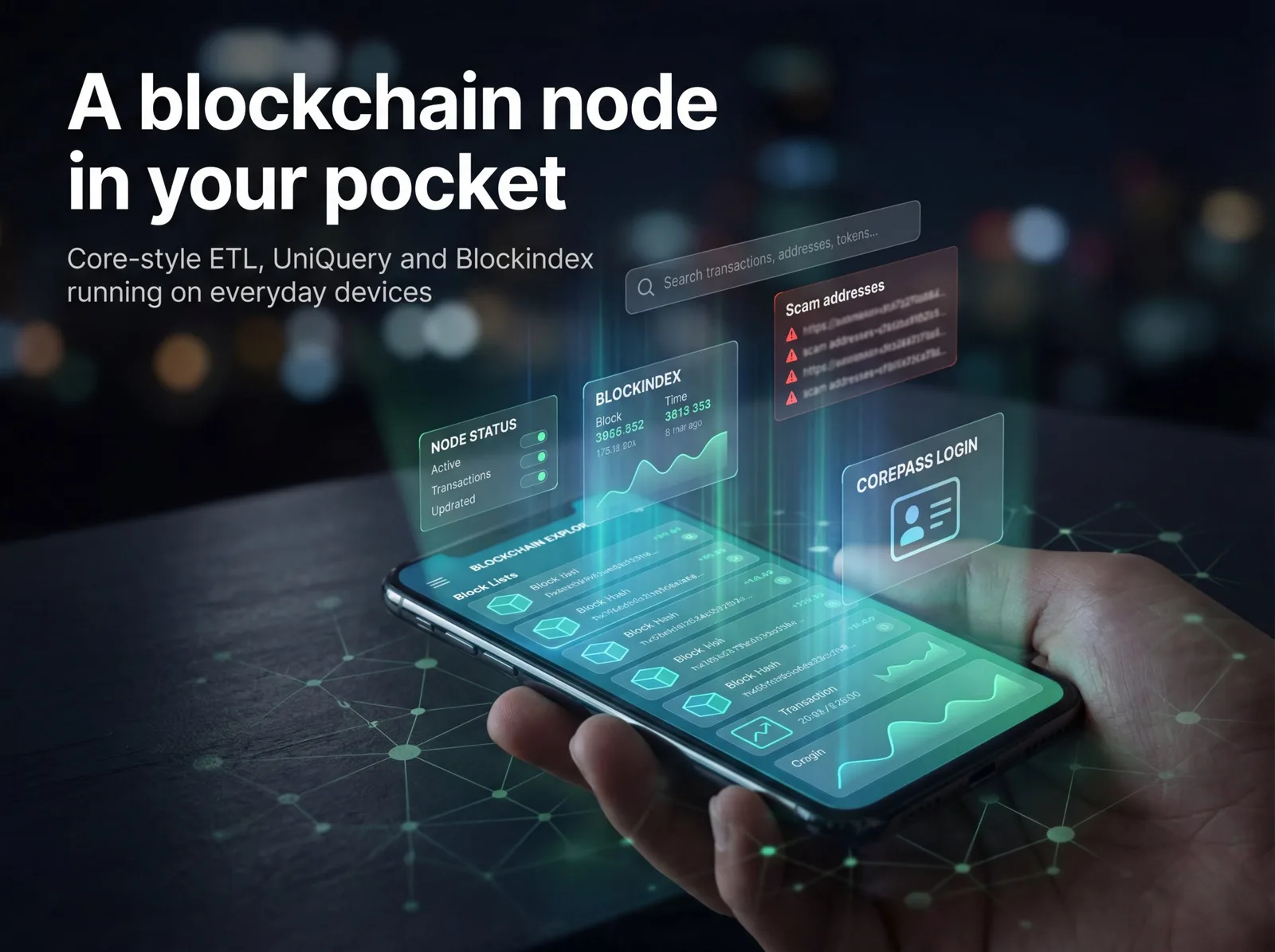
With components such as Core ETL and UniQuery, the system is designed so that blockchain nodes and data pipelines can also run on resource‑constrained devices – up to and including smartphones and IoT hardware. Instead of "a few big full nodes in a data centre", you get the perspective of "blockchain nodes on mobile devices".
Building on this, Blockindex functions as an explorer and analytics layer:
– search across transactions, blocks, tokens, addresses, names or QR codes,
– dashboards, logs and scam‑address lists for transparency,
– login via CorePass, so identity and usage can be cleanly linked.
The difference from classical architecture is clear: the "node + explorer" function is not outsourced into a central web frontend, but designed so that it can technically move all the way down to the endpoint device. Anyone wanting to verify this can visit the live explorer at pingexplore.com.
3. Connectivity without the internet: Lunaº Mesh and transactions via SMS
A blind spot in many decentralisation debates is the question: what happens when the internet goes down – through outages, political interference or crises? A network that is "decentralised" but tied to a few backbones is only resilient up to a point.
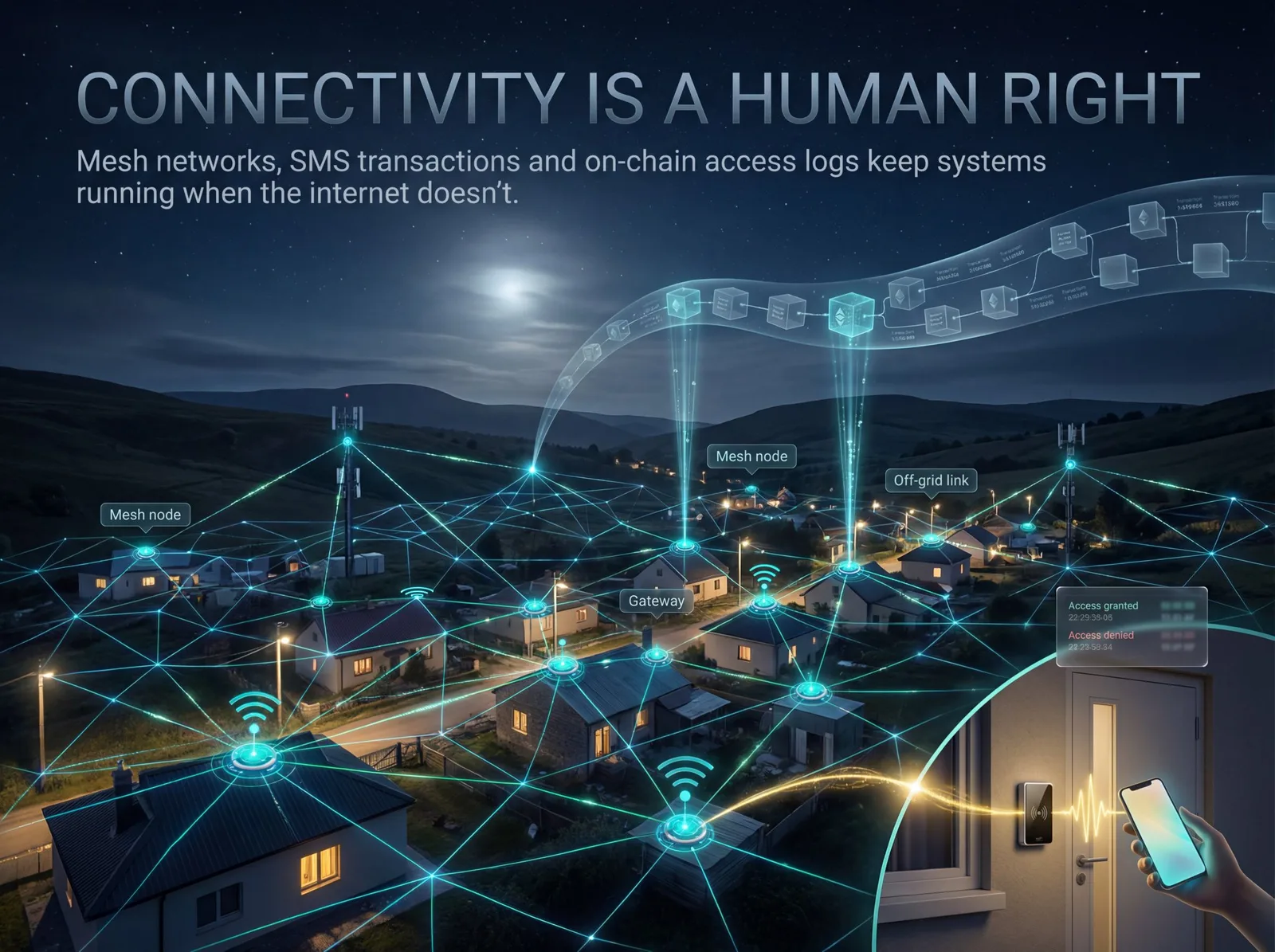
Lunaº Mesh directly addresses this weak point. The system is designed as a DePIN mesh network without a central node, enabling peer‑to‑peer communication over multiple carriers – such as Wi‑Fi, radio, mobile networks or other channels.
Nodes can be deployed in fixed locations, on the move or even via drone. Data packets are forwarded over several hops until they reach a node with internet or gateway connectivity.
In addition, a transaction layer such as TxMS ("zero‑G") allows blockchain transactions via SMS/MMS: a few text messages per transaction, aimed at rural regions, emergencies or low‑bandwidth situations.
A concrete example: a farmer in Sub‑Saharan Africa or a remote part of Southeast Asia with no stable internet connection could trigger a supply‑chain confirmation on the blockchain via TxMS – using nothing more than a basic phone with SMS. No broadband, no smartphone, no app required.
The technical direction aligns with a clear stance CoDeTech states openly: "It's in our opinion that connectivity is a human right." If you treat connectivity as a basic right, a network that only works as long as major providers, fibre and data centres are up is not enough – it must keep functioning even when all of that fails.
For readers who followed our earlier article "Connectivity Is a Human Right": this is that principle translated into protocol design.
4. Self‑sovereign identity instead of “login with BigTech”
Not only money, but identity is a central power lever in the digital space. Today those levers mostly sit with a few platforms – "Login with X" or "Login with Y" are convenient, but centralised.
CorePass provides a counterpoint. The app is designed as a decentralised identity wallet in which users can digitise and manage official documents and attributes.
– Data is verified using the Core Blockchain but remains under the user's control – not in large central databases.
– Attributes (e.g. age proof, company role, address) can be shared selectively and purpose‑specifically.
– Disclosures can be proven cryptographically and made auditable.
Platforms such as Ping Exchange Exchange or banking frontends use CorePass to enable passwordless login, KYC/KYB and transaction approvals. The identity layer remains in the user's hands rather than with a large identity provider.
Here, decentralisation means: I bring my identity with me – I do not borrow it from a platform.
5. Communication and physical infrastructure as part of the ledger
Many blockchain projects focus almost exclusively on the financial layer. CoDeTech explicitly includes communication and physical infrastructure as well.
On the communication side, there is a P2P approach that can run over mesh networks: end‑to‑end encrypted messages and calls that do not have to be routed via a central server. Combined with Luna Mesh, this means communication can continue even without SIM cards or traditional internet, as long as nodes are in range.
On the physical side, access‑control scenarios have been demonstrated where doors and entry points are controlled via NFC cards, smartphones or RFID tags:
– every "access granted / denied" event lands on the Core Blockchain with timestamp, status and (pseudonymised) ID,
– parts of the infrastructure can connect via Luna Mesh, for example from rooftops or remote locations without direct internet lines.
Buildings, sites or entire cities thus become part of an immutable audit trail – not just wallet addresses and tokens.
6. From coin to stack:
identity, data, value, real‑world assetsOn the same layer‑1, the ecosystem bundles multiple layers that are separate or only loosely coupled in many projects:
– tokenisation of assets, goods and products, including digital product passports for supply chains and sustainability data,
– trading infrastructure such as Ping Exchange for commodities, energy and certificates,
– DeFi modules like DEX/AMM components,
– payment and settlement solutions for everyday use (PayTo, ICAN‑style approaches, on/off‑ramps),
– programmable stable tokens with on‑chain proofs instead of PDF promises,
– banking frontends that offer multi‑asset management on top of this infrastructure.
The common denominators are:
Core Blockchain as the base ledger,
PoDE as an energy‑efficient, hardware‑oriented consensus,
CorePass as identity layer,
Luna Mesh and DePIN as connectivity layer.
The idea is not "one chain, one coin, one use case", but a stack that is consistently designed from identity and data all the way to payments and real‑world assets.
7. Where CORE sits in the DePIN landscape
The DePIN sector (Decentralised Physical Infrastructure Networks) is one of the fastest‑growing segments in the blockchain space. According to CoinGecko data, total DePIN market capitalisation reached roughly $19.2 billion by September 2025 – up from $5.2 billion a year earlier. The World Economic Forum projects a potential market of $3.5 trillion by 2028.
Most DePIN projects operate vertically: Helium covers wireless and IoT with over 115,000 hotspots and 1.9 million daily users, Filecoin addresses decentralised storage, Render provides GPU computing for AI and media. Each solves one layer – and solves it well.
CORE's approach is horizontal: rather than addressing a single infrastructure silo, the stack integrates identity (CorePass), connectivity (Luna Mesh), consensus (Core PoDE), payments (PayTo, MoneyX) and real‑world asset pipelines into one architecture. Luna Mesh in particular goes where Helium stops: not just network coverage, but communication and transactions entirely without internet infrastructure.
That breadth is the ambition – and, honestly, also the challenge. Which brings us to the part most projects skip.
8. What is still open – an honest look
No technology stack exists without open questions. In the spirit of the transparency this project deserves:
Adoption: compared to established DePIN projects like Helium (1.9 million daily users, carrier partnerships with AT&T and T‑Mobile), CORE is at an earlier stage of network distribution. That is not a flaw – it is the logical position on a roadmap that starts at the foundation, not at the marketing layer.
Visibility: the full‑stack approach is technically one of the most comprehensive in the blockchain space, but not yet as widely known as specialised projects. Awareness is growing – but it takes time, especially when you do not pay for influencer funnels (as we explained in "Invisible in the crypto hype").
Verifiability: features like TxMS and large‑scale mesh deployments are at different stages of maturity. Anyone who wants to see live activity can visit the Blockindex explorer at pingexplore.com and follow transactions, blocks and network metrics in real time.
This honest look is not a concession of weakness. It is the difference between a project that sells narratives and one that builds infrastructure. We covered this distinction in detail in "The $100 Trillion Illusion" – the same principle applies here.
9. Conclusion: real decentralisation is more than kWh per transaction
The debate around Bitcoin and the climate often revolves around one question: "How many kilowatt‑hours does the network use – and how many of them are renewable?" That matters, but it is not enough.
Real decentralisation answers different questions:
Can I participate in consensus with normal hardware – or do I need a factory hall?
Can nodes move down to smartphones and IoT devices, instead of ending up in a few data centres?
Does the network keep working when traditional internet infrastructure fails – or does everything stop?
Do users own their identity and data – or do a few platforms?
Are physical processes, energy and logistics chains, cities and access systems integrated – or just token speculation?
CoDeTech aims to answer exactly these questions at the protocol level: with PoDE mining on small devices, "nodes in your pocket", mesh networks without ISPs, self‑sovereign identity and a stack that brings real infrastructure directly onto the ledger.
Against this backdrop, the focus shifts away from merely defending an old model towards asking what decentralisation has to look like in 2026 if it is to be more than a label. In this sense, the statement "Connectivity is a human right" is not just a slogan, but a design criterion for deciding who will actually be included in the next evolution of blockchain infrastructure.
If the only blockchain progress you ever hear about is that Bitcoin's energy mix improved, you are seeing a small part of a much larger evolution. The real question is no longer whether we can justify old architectures with better arguments – but why we should accept them as final, when systems exist that combine security, decentralisation and real‑world utility by design.