
Deep dive
Why Luna Mesh Is More Than “The Next Helium”
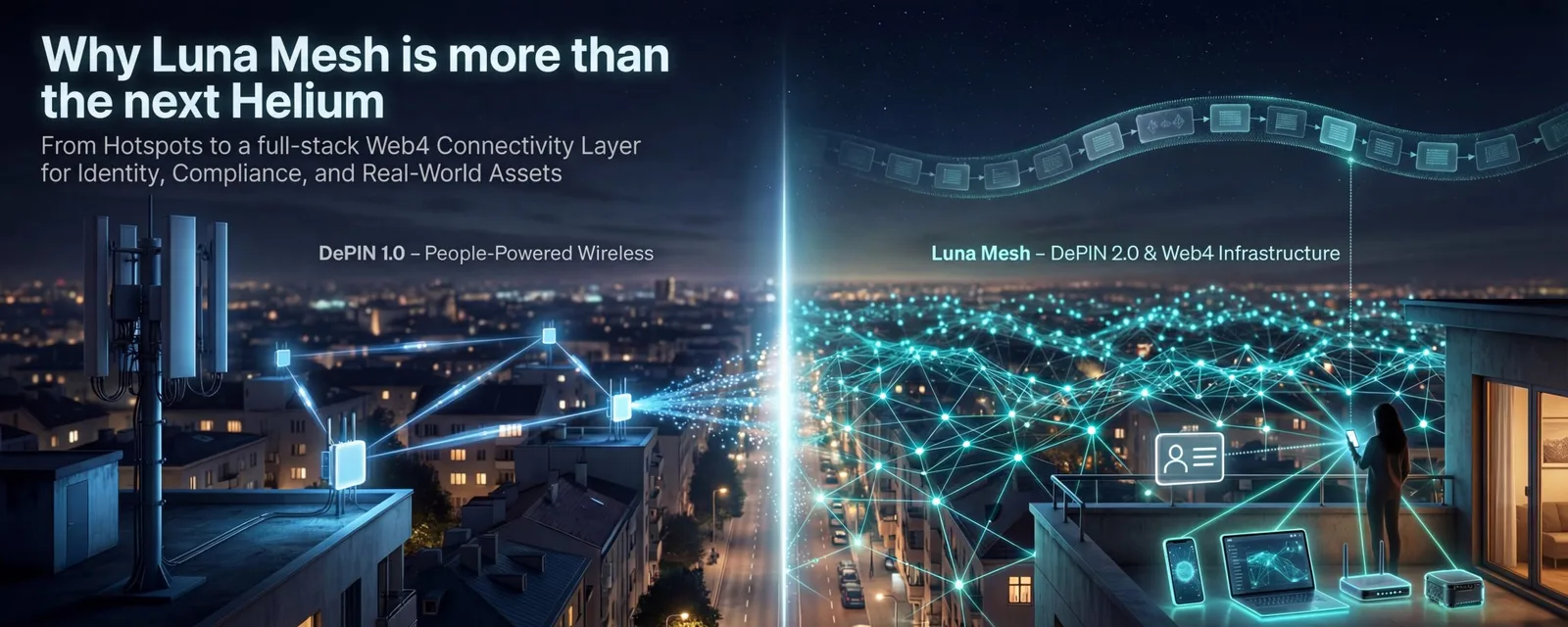
This thread is for everyone asking: "What comes after Helium – and what does a real DePIN operating system for smart cities and industry look like?"
People‑powered networks were Helium 1.0. Luna Mesh is 2.0: it runs on any compatible device, works without the internet and connects directly to identity, compliance and real‑world assets. In short: Telco as a Web4 stack.
Over the past years, "people‑powered connectivity" has proven to be more than hype – it is a new infrastructure paradigm. Helium showed that ordinary people with small radio devices can build nationwide networks and get rewarded with a token for providing coverage. As of mid-2025, Helium operates over 115,000 hotspots across more than 80 countries, serves 1.9 million daily users, transferred 2,721 terabytes of mobile data in Q2 2025 alone (+138.5% quarter‑over‑quarter), and maintains carrier partnerships with AT&T, T‑Mobile and Telefónica. That is a remarkable achievement – and the proof of concept that DePIN works.
The next evolution goes beyond "hotspots instead of towers": a connectivity layer that can run on a wide range of devices, works even without the internet, and is directly connected to digital identity, compliance and real‑world assets. This is exactly where CoDeTech positions itself with Core Blockchain, CorePass and Luna Mesh.
Important note for clarity: Core Blockchain (XCB) by CoDeTech is not the same as "Core DAO" (CORE token, Satoshi Plus consensus). These are entirely separate projects with different teams, architectures and goals. This article refers exclusively to the CoDeTech ecosystem.
1. Helium Proved the Concept – Now Comes the Full‑Stack Generation
Helium made a few things very clear:
Traditional telcos are expensive and slow to scale. Community‑run networks can deliver coverage faster and cheaper. Token incentives can bootstrap a global network.
Helium deserves credit for proving all three – and for surviving the hard transition from IoT to 5G with real carrier integrations. But Helium's primary focus is radio connectivity: hotspot operators provide coverage, while identity, regulation, data governance, tokenization and payments live in separate stacks.
In that sense, Helium is DePIN 1.0 for telco: strong on reach, deliberately light on identity, compliance and the finance layer. The question is not "is Helium good?" – it is "what needs to come next?"
2. CoDeTech & ARAX: An Operating System for the Real Economy
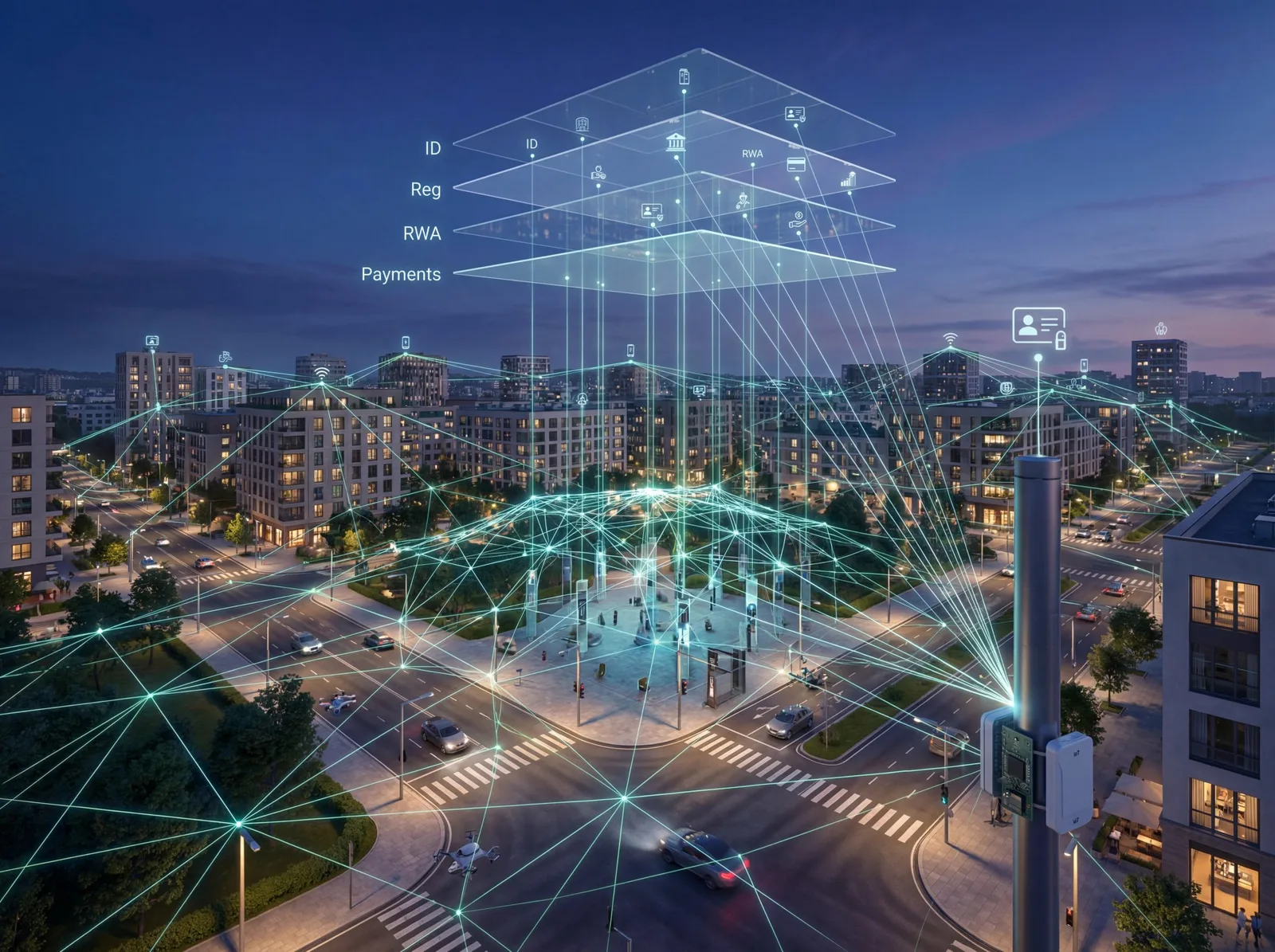
CoDeTech and ARAX have not built "just" a network – they are assembling a full Web4 infrastructure stack.
Core Blockchain: a dedicated Layer‑1 with energy‑efficient PoDE mining on IoT devices (5–15 watts per node), short block times and a focus on real‑world data and financial flows. CorePass: a decentralized, GDPR‑compliant digital identity for people, organizations, devices and assets. Token standards & RWA: infrastructure for fungible tokens, digital product passports and tokenized real‑world assets. ARAX BaaP: a Blockchain‑as‑a‑Platform layer that connects blockchain, AI, IoT, DePIN and ESG reporting into existing enterprise processes. Payments & DeFi: solutions like MoneyX (Class 1 Stable Token with on‑chain proof of reserves), PayTo (programmable payments, 42s finality) and other Core‑based rails that attach real payments and FX flows directly to the infrastructure.
Within this stack, Luna Mesh is the connectivity layer – the physical nervous system that carries data and value even where traditional infrastructure fails.
As we explored in our earlier article "The $100 Trillion Illusion", an RWA system that goes offline when the Wi‑Fi goes down is not fit for critical infrastructure. Luna Mesh is the answer to that connectivity trap.
3. What Luna Mesh Does Fundamentally Differently From Helium
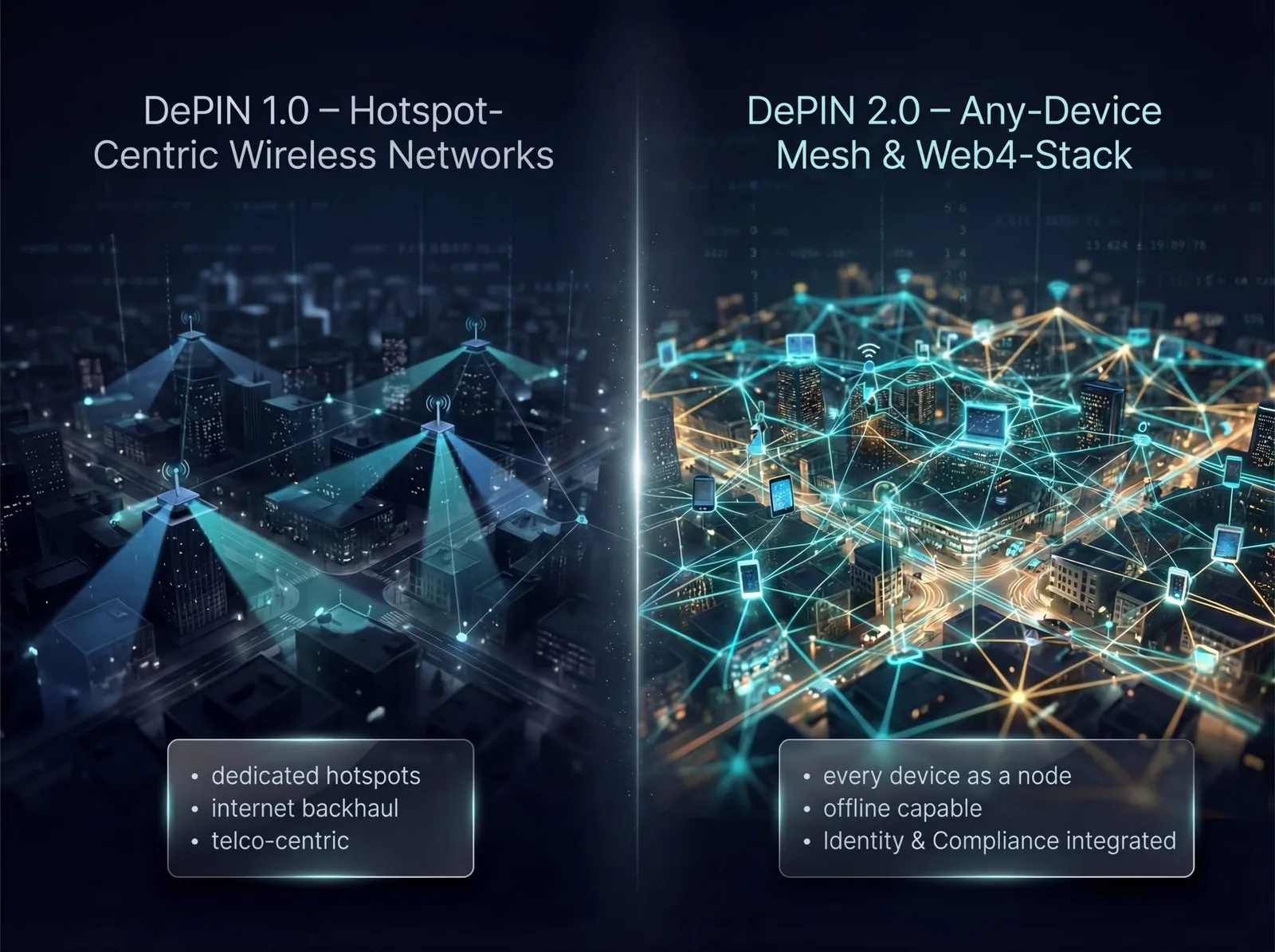
3.1 Helium vs. Luna Mesh – at a Glance
Helium (DePIN 1.0): – Proprietary hotspots (dedicated hardware purchase required) – Needs internet backhaul to function – Focus: radio coverage and IoT/5G connectivity – 115,000+ hotspots, 1.9M daily users, carrier partnerships (AT&T, T‑Mobile, Telefónica) – No native identity, compliance or RWA layer
Luna Mesh (DePIN 2.0): – IoT devices, routers, edge hardware, standard Wi‑Fi devices can act as nodes – Works even without internet (offline‑first architecture) – Integrated with identity (CorePass), RegTech (goAML 5.0), RWA & smart‑city use cases – Earlier stage of deployment – building on architectural depth rather than hotspot count – Direct connection to payment rails, tokenization and compliance stack
This is the core difference at a glance – the rest of the thread digs deeper into it.
3.2 Any Compatible Device Can Be a Node
Luna Mesh is designed to use what is already out there: IoT devices, routers, edge hardware and standard Wi‑Fi devices can act as mesh nodes without requiring proprietary hotspot hardware. In low‑infrastructure regions, simple low‑power devices are enough to stand up communication and routing – no million‑dollar towers required.
3.3 Connectivity as a Human Right – Therefore Offline‑First
CoDeTech explicitly frames connectivity as a human right and designs Luna Mesh accordingly. As we argued in detail in our article "Connectivity Is a Human Right", when education, work, money and government run through networks, connectivity determines who is part of society and who is stuck at the margins.
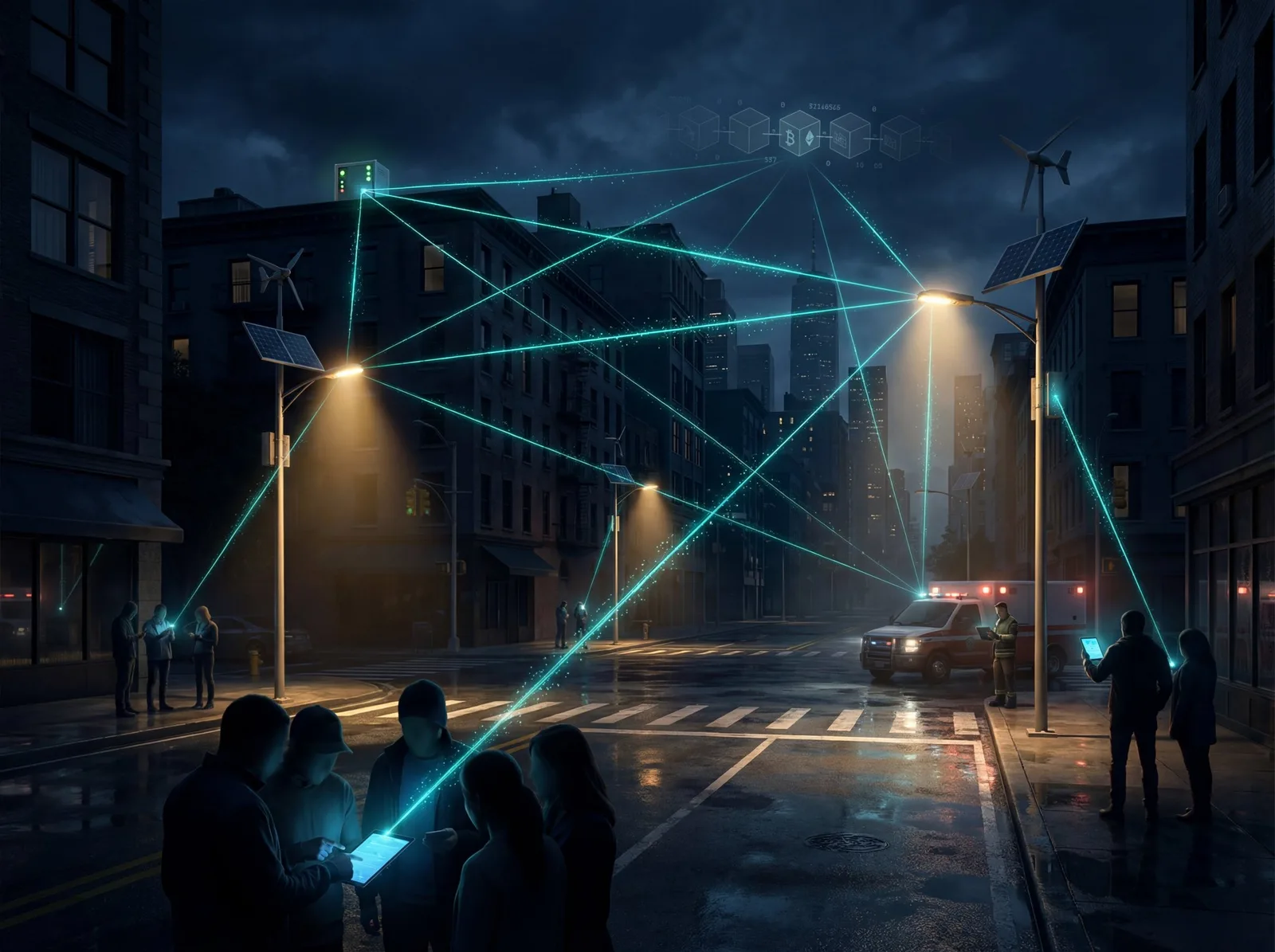
Mesh without internet: communication can stay entirely inside the mesh, which is ideal for rural areas, mines, crisis regions and disaster scenarios. Deferred synchronization: access‑control events, sensor data or messages can be cached locally and written to Core Blockchain once a "point of presence" is available. Multi‑layer transport: classic internet, mesh, low‑bandwidth channels (including TxMS/zero‑G transactions via SMS) and LEO satellites are combined to keep payments and data streams resilient.
Helium is powerful as long as internet backhaul is available; Luna Mesh was intentionally built to keep working even when it is not.
3.4 Full‑Stack Integration: Identity, Compliance, RWA & Smart City
Luna Mesh plugs directly into the higher layers of the CoDeTech/ARAX stack:
CorePass can attach verifiable identity to each transaction, door event or sensor message when needed. RegTech & goAML integrations route the right data straight into AML and regulatory workflows. Smart‑city, ESG and RWA projects use Luna Mesh as the data and connectivity backbone – from intelligent street lighting to environmental monitoring and tokenized infrastructure assets.
Helium proved that community‑powered coverage works at global scale; Luna Mesh builds on that proof by adding identity, audit trails and direct access to regulated financial and government use cases.
4. Hero Use Cases – Not a Smart‑City “Big Bang”
Instead of requiring a full smart‑city masterplan, Luna Mesh deliberately starts with simple, high‑impact scenarios.
Hero use case 1: mid‑sized city in blackout "City X deploys a Luna Mesh emergency network with just 5 smart poles – and still has working communication during a blackout." A handful of autonomous smart poles with mesh nodes are enough for citizens and emergency services to keep texting, warning and coordinating – regardless of mobile network status.
Hero use case 2: mining community off the grid "A mine in country Y: workers and families can chat over mesh, even though there is no mobile coverage." Luna nodes around the mine and nearby village connect phones, sensors and safety systems into a dedicated, resilient network – data is synced back to Core Blockchain when connectivity is available.
Hero use case 3: Tuzla (Romania) – from streetlight to DePIN node This is not a slide in a pitch deck, but a real proof‑of‑concept. ARAX and the municipality of Tuzla are building a DePIN‑based platform starting with intelligent streetlights. Each streetlight becomes a Luna Mesh base node:
– Vertical wind turbines, solar panels, hybrid inverters and battery storage as the physical energy base. – A communications layer with mesh connectivity via WiFi, LPWAN and 60 GHz microwave backhaul that links sensors, meters and IoT devices in a self‑healing network. – A data & logic layer built on ARAX BaaP and Core Blockchain that processes real‑time data for energy optimization, monitoring and smart‑contract automation.
The architecture is designed to add further applications on top: from smart parking and waste management to public WiFi zones and distributed storage. As we detailed in "Not Chips, but Power", while Davos debates AI satellites, Tuzla already has physical DePIN nodes hanging from street poles that combine energy, data and network capacity in a single system.
On top of that, you get: Access control without internet: doors and gates controlled via mesh, with each decision written on‑chain within seconds. Industrial & logistics telemetry: vehicles and machines stream data over mesh, while only the relevant events are anchored on‑chain as tamper‑proof evidence.
These low‑complexity scenarios work on day one – and they open the path to full smart‑city deployments, ESG reporting and tokenized infrastructure.
5. Tokenomics: Dual Model, Not Artificial Brakes
The CoDeTech ecosystem operates a dual‑token model designed to separate infrastructure from utility:
XCB (Core Coin): the native infrastructure coin of Core Blockchain. XCB is used to process all hash transactions and network fees, with an annual supply of 18–22.5 million. XCB is mined via PoDE on IoT devices, rewarding node operators who provide real infrastructure capacity – compute, storage and connectivity.
CTN (Core Token): the utility token for ecosystem applications. CTN is designed with a fixed supply of 1 billion tokens and serves as the access and governance layer for services built on top of Core Blockchain – including CorePass identity, Ping Exchange Exchange and DePIN participation.
This separation means: DePIN contributions such as mesh nodes, storage or services are rewarded through the infrastructure layer (XCB), while ecosystem participation flows through the utility layer (CTN). More devices mean more capacity, more settlement and more real‑world use cases, not more friction from a single overloaded token.
The design principle is straightforward: reward real infrastructure, not speculation. As more nodes join, network capacity grows – and with it, the settlement volume and utility that underpin both tokens.
6. What Is Still Open – An Honest Look
No technology stack exists without open questions. In the spirit of transparency:
Network scale: Helium's 115,000+ hotspots and 1.9 million daily users represent years of deployment and carrier integration. Luna Mesh is at an earlier stage of network rollout. The Tuzla pilot and additional deployment scenarios are building real‑world validation, but the gap in raw node count is real. That is the nature of starting at the foundation rather than the marketing layer.
Hardware ecosystem: Helium transitioned from proprietary to open‑source hardware specs over time, enabling a broad manufacturer ecosystem. Luna Mesh's "any compatible device" approach avoids the proprietary lock‑in problem, but the practical hardware ecosystem is still developing.
Carrier partnerships: Helium's integrations with AT&T, T‑Mobile and Telefónica represent significant validation. Comparable carrier‑level partnerships for Luna Mesh have not yet been publicly announced. The CoDeTech approach targets municipalities and industrial partners first (Tuzla model), which is a different go‑to‑market path.
Verifiability: anyone wanting to check live activity on Core Blockchain can visit the Blockindex explorer at https://blockindex.net. Luna Mesh deployment data will become more publicly visible as pilots scale.
This section is not a disclaimer – it is the difference between a project that sells futures and one that builds infrastructure. As we noted in "From mining farms to real decentralisation": a project that only shows strengths loses credibility. CORE builds on a long‑term architecture approach – and that is exactly how it should be evaluated.
7. Verdict & Call to Action
Helium proved that people are willing to own and operate connectivity if they can participate in the upside – "own the air" is no longer a theory. That achievement stands, and Luna Mesh builds on it rather than replacing it.
CoDeTech takes the next step with Core Blockchain, CorePass, ARAX BaaP and Luna Mesh:
"Own the air" combines with "own the data" and "own the identity". Not just dedicated hotspots, but entire device fleets and existing IoT infrastructure become part of the network. Connectivity is no longer the end product, but the foundation of a regulation‑ready operating system for the real economy, cities and industry.
TL;DR: Helium was the starting gun. CoDeTech with Core Blockchain, CorePass and Luna Mesh is building the operating system that Web4 cities and industries can actually run on.
If you want to see more about real pilots (smart cities, mining, industry): Follow the official CoDeTech/ARAX channels – and drop "LUNA" in the replies if you want to go deeper into real DePIN use cases.
For context and background, see our earlier articles in this series: – "Connectivity Is a Human Right" – the philosophical foundation – "From mining farms to real decentralisation" – PoDE, energy efficiency and the DePIN landscape – "Not Chips, but Power" – Tuzla, smart cities and the AI energy bottleneck – "The $100 Trillion Illusion" – why most RWA projects fail without identity, connectivity and settlement – "Bitcoin, greenwashing and better alternatives" – why "less bad" is not "solved"