
Essay
Four Years. No Reset Button.
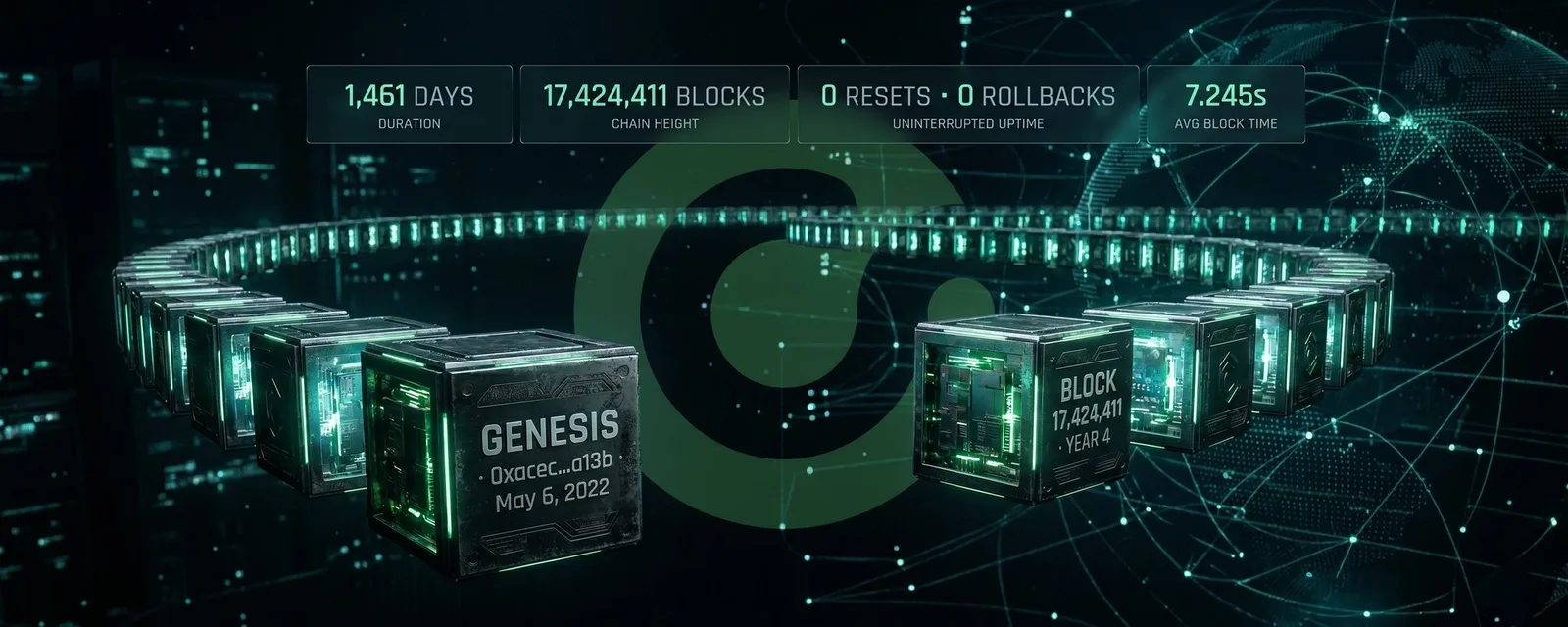
Four years ago today, the Core Blockchain (XCB by CoDeTech — not the unrelated Core DAO chain that shares the word) produced its first block, and it has not stopped since. 17,424,411 blocks. 1,461 days. Zero coordinated halts. Same genesis hash, same chain, no "v2 mainnet" reset, no hard-fork that pruned the history.
That sentence is the entire story of this anniversary. The rest of this article is just unpacking why almost nobody in crypto talks about it — and why that silence is itself the most interesting thing about it.
For the record: the genesis block is 0xacecc18e30188588d4932a29df096198bbbe01a955f05ecd32489a7740a9a13b, mined on May 6, 2022 — the day Core's mainnet went live. Every transaction on the network today still links back to that block.
TL;DR
- The Core Blockchain (XCB) hit its fourth mainnet anniversary on May 6, 2026 — 1,461 days of continuous block production with zero coordinated halts and no history-rewriting forks.
- Current chain state: 17,424,411 blocks, average block time 7.245s against a 7-second nominal target, genesis hash unchanged since day one.
- The 7-second block target is the deliberate middle between speed and security — a foresight bet placed long before AI-driven attack patterns and post-quantum cryptography became mainstream concerns.
- Hidden milestones from the engine room: ED448 cryptography, 22-byte ICAN addresses (CIP-100), PoDE consensus on 8–15W IoT hardware, 31 ratified CIPs, and 13 years of founder continuity.
- Why it matters: Wall Money, PayTo, MoneyX, Ping Exchange and ARAX's BaaP layer all need a settlement constant. Four years of clean operation is the first empirical leg of that proof.
1. The number nobody quotes
Most chains advertise their TPS. A few quote validator counts. Almost none publish their continuous-uptime number, because almost none can.
Solana has publicly recorded multiple mainnet outages since 2021, including a roughly five-hour halt in February 2024. Ethereum's beacon chain went through a finality incident in May 2023 that spooked a lot of people in the room. Aptos paused. Sui rolled back. Avalanche had its X-chain incident. The list isn't an attack — it's just what happens when you ship complex distributed systems.
Core, by contrast, hit four years today: 1,461 days of continuous block production, an average block time of 7.245 seconds against a nominal target of 7 (computed against the live block height on blockindex.net). Not a single public halt event in its history.
That's not the kind of number that drives an affiliate funnel. There's no chart to screenshot, no "100x by Q3" frame to wrap it in. It's a quiet metric that only matters if you're the one trying to actually settle something on the chain.
For a Visa-style payment rail that's supposed to anchor CoDeTech's Wall Money, PayTo and MoneyX, "the rail was up every day for four years" is not a vanity line. It's the entire premise.
2. The engine room nobody photographs
The thing about a chain that runs like clockwork is that the clockwork itself is the story — and clockwork doesn't tweet.
A few of the parts that have been ticking since day one and rarely get airtime:
Seven seconds, on purpose. Block time is one of the few architectural decisions a chain cannot un-make. Faster blocks settle quicker but give attackers less work to fight against. Slower blocks lock in finality but stall payments. Core picked 7 seconds as the deliberate middle: fast enough that a six-block confirmation gives merchants a workable ~42 seconds of accumulated security, slow enough that PoDE miners on 8–15-watt hardware can keep up across continents without centralisation pressure. That choice was made in the whitepaper years before "AI-driven attack discovery" or "post-quantum cryptography" had hit a single boardroom slide deck. The chain bet, early, that security headroom would matter more than headline TPS. Four years later, in an era where machine-learning systems are systematically probing protocol weaknesses and quantum timelines are no longer hypothetical, that bet looks better with every block. The 7-second target hasn't moved.
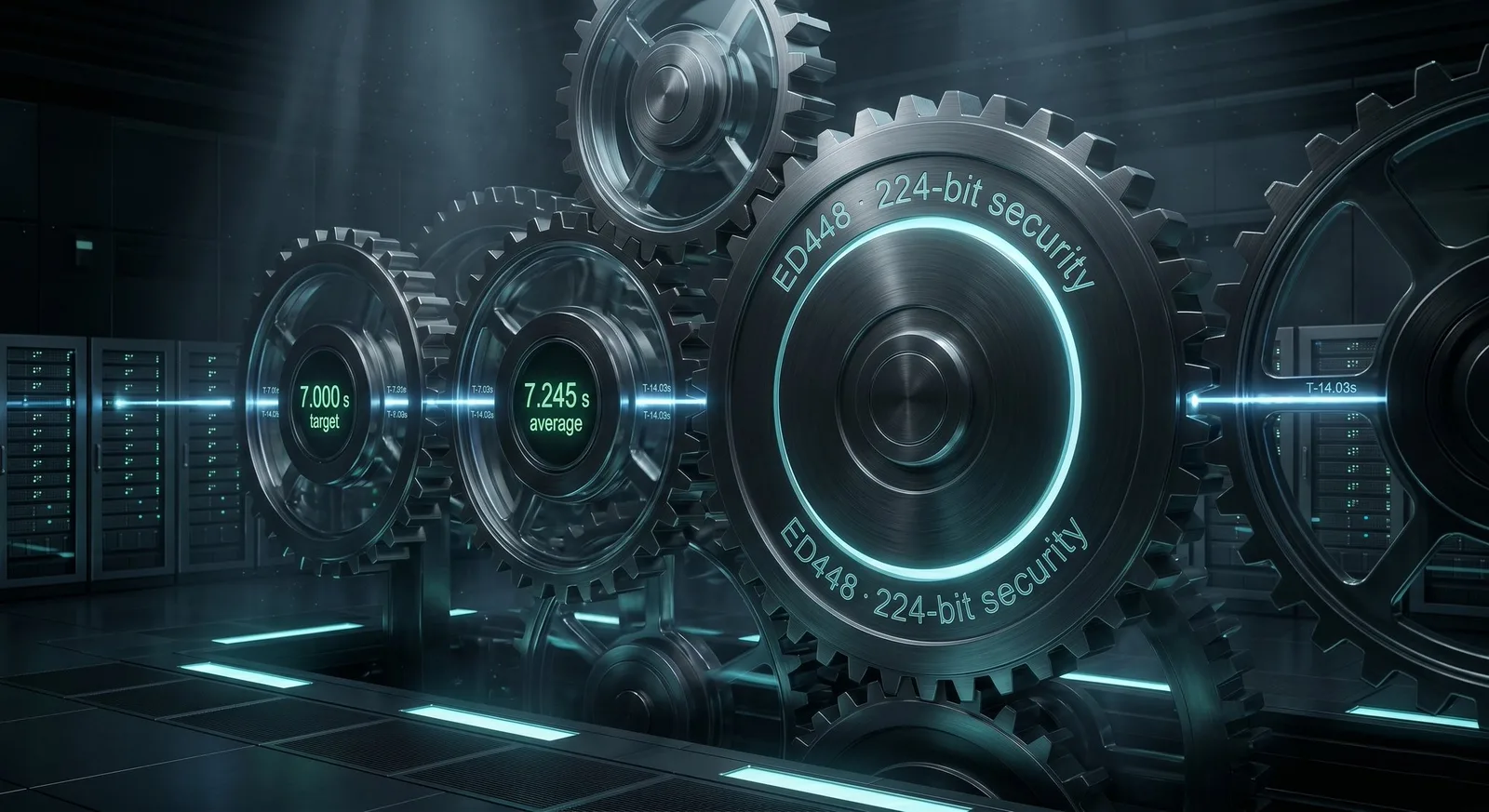
ED448-Goldilocks signatures. This is the same foresight applied to cryptography. Core launched in 2022 with 224-bit elliptic-curve security — a deliberate step beyond the secp256k1 standard the rest of the industry uses. The decision was made years before "post-quantum" became a marketing term. Four years on, no migration, no sudden "we're upgrading our crypto" announcement. It just works.
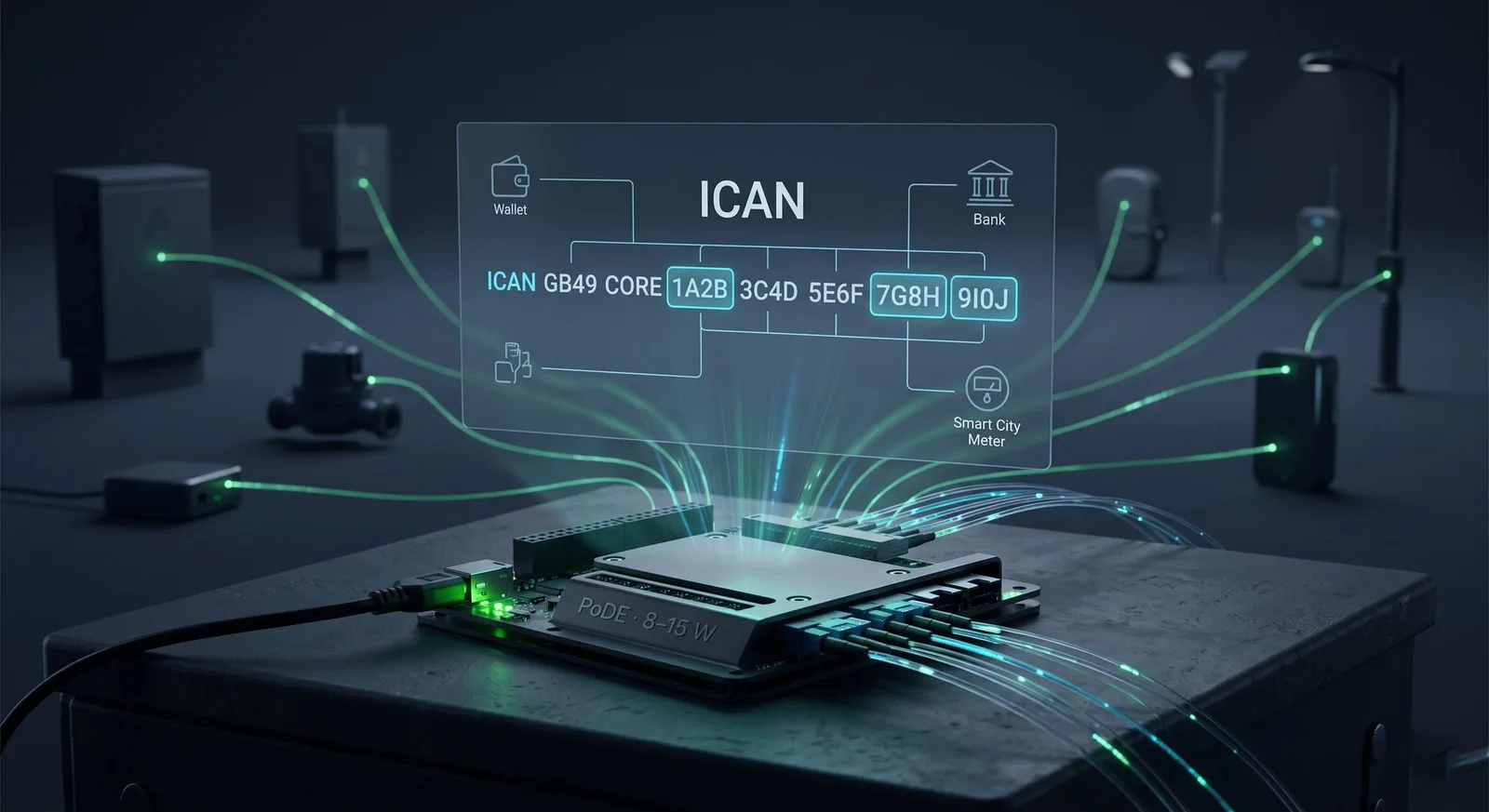
22-byte ICAN addresses. While Ethereum-likes still use 20-byte hex strings that mean nothing to a bank, every Core address since block zero has carried a checksum-validated International Crypto Account Number — the same structural pattern as IBAN. CIP-100 isn't a future proposal. It's been live for 1,461 days.
PoDE on IoT hardware. Proof of Distributed Efficiency was supposed to be the contrarian bet: a Proof-of-Work variant designed for 8–15 watt devices instead of warehouse farms. Four years of mainnet later, it's still the consensus mechanism — running on water meters in ARAX's smart-city pilot in Tuzla and on single-board computers in basements. No pivot to PoS, no "ETH-style merge" mid-flight.
The CIP suite. Thirty-one Core Improvement Proposals are now ratified, including a complete CBC token-standards stack (CIP-20 through CIP-4626), the CVM execution layer with native ICAN support, and the CIP-150 series for RWA metadata. Most of the work happened in the open, in a repo most people in crypto have never opened: core-coin/cip.
Founder continuity. Michael Loubser, Ockert Loubser and Rastislav Vašička have been on this since 2013. That's nine years of pre-mainnet engineering plus four years of post-launch operations. Thirteen years on the same problem, with the same three names. In a market where founder churn happens between bull cycles, that is itself a non-trivial milestone.
3. Why this is the part nobody sees
The crypto information market is structurally hostile to anniversaries that aren't chart events.
A four-year uptime story doesn't fit an affiliate funnel. There's no signal group that benefits from telling you "the rail held." Influencer economics reward "10x in 10 days" framings, not "1,461 days of clean blocks." AI-driven research tools reproduce whatever is already loud — which means a chain that quietly mines its 17-millionth block on a Tuesday morning will never appear on a "trending L1s" board.
The CoDeTech founders have been blunt about this for years. This stack is not built to flip. It is built to still be running in twenty years the way it runs today. Four years in, that posture has receipts. The block heights are the receipts.
4. What "running like clockwork" actually means
Clockwork is a precise word. It doesn't mean "fast." It doesn't mean "exciting." It means predictable to the point of being boring.
A clock that needs constant attention isn't a good clock. A chain that needs emergency hard-forks, validator-set rewrites or coordinated rollbacks isn't infrastructure — it's a project still in beta, regardless of what the marketing page says.
For the merchants CoDeTech is courting with PayTo and Wall Money, "boring" is the entire feature. A baker in Vienna doesn't want a settlement rail that occasionally pauses for "scheduled maintenance." A regional bank looking at MoneyX as a stable-token issuance layer doesn't want a chain that publishes a 90-page post-mortem twice a year. They want the dial tone — the sound of a system that is so reliably there that you stop noticing it.
That's the bar Core has been clearing since May 6, 2022. Not loudly. Not with a lap of victory. Just one block every seven seconds, signed with ED448, addressed in ICAN, mined on a watt-budget that wouldn't power a fridge.
5. The four-year tell
The interesting question isn't whether Core hit four years. The chain doesn't care about anniversaries; it just keeps producing blocks. The interesting question is what those four years tell you about everything that comes next.
Wall Money's banking-group integration — SWIFT MT940, SEPA XML, ICAN as the bridge format — only works if the underlying chain can be treated as a settlement assumption rather than a risk factor. Ping Exchange's DvP-T+0 commodities flows only work if finality can be promised in seconds, not asterisked. ARAX's enterprise BaaP layer for cities and life-settlements only signs if the rail has the kind of operational track record that procurement teams actually accept.
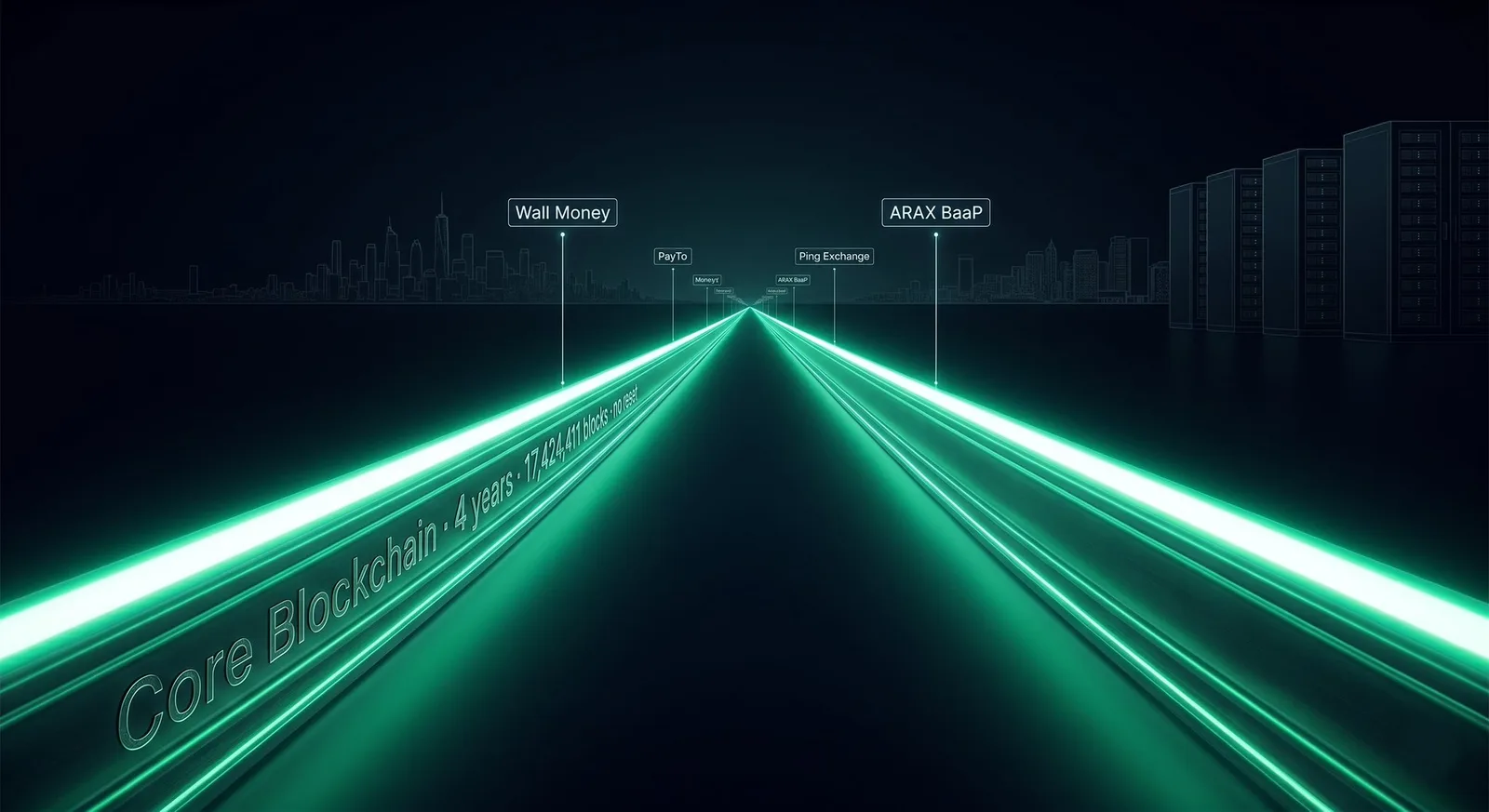
Four years of clean operation is not the end of that proof. It's the first part of it that's now empirically settled. The next decade is when the bet pays out — or doesn't.
What four years on a public ledger makes visible is exactly what an honest infrastructure chain should make visible. Depth-1 reorgs show healthy miner competition. Difficulty adjustments track real hashrate. The active mining set keeps growing as more PoDE hardware joins. All of it on blockindex.net for anyone who wants to look — and all of it consistent with the headline number: zero coordinated halts, zero history-rewriting forks, zero "we're rolling back to block N" events. Held for 1,461 days running.
6. Bottom line
Most of crypto measures itself in cycle peaks. Core measures itself in blocks. Today, the count reads 17,424,411, and the genesis hash is still 0xacecc18e..., exactly where it was four years ago this morning.
If the next wave of Web 4 infrastructure — tokenized RWAs, programmable payments, identity-bound settlement — is going to ride on a chain, it will ride on one that has already proven it can simply keep running. Not promised it will. Proven it has.
Four years. No reset button. That's the entire pitch.