
Article
CoDeTech founder spoke for 72 minutes. Here's what matters

CorePay went live on June 4th.
The day before, the man who built it sat in a Telegram voice chat for 72 minutes answering whatever a crypto community threw at him. No slides. No PR handler in the background. Ockert Loubser — co-founder of CoDeTech and the Core Blockchain — showed up in the Whale Sailors channel and talked through the full stack, start to finish.
That context matters for how you read what he said.
TL;DR
- Okkie built CoDeTech as a complete infrastructure stack, not a product — the Core Settlement Network is the rail that ties identity, payments, exchange, banking and tokenization together.
- CorePay launched on June 4th: any user with a CorePass account and a Ping Exchange account can now become a merchant. Recurring payments in crypto are included.
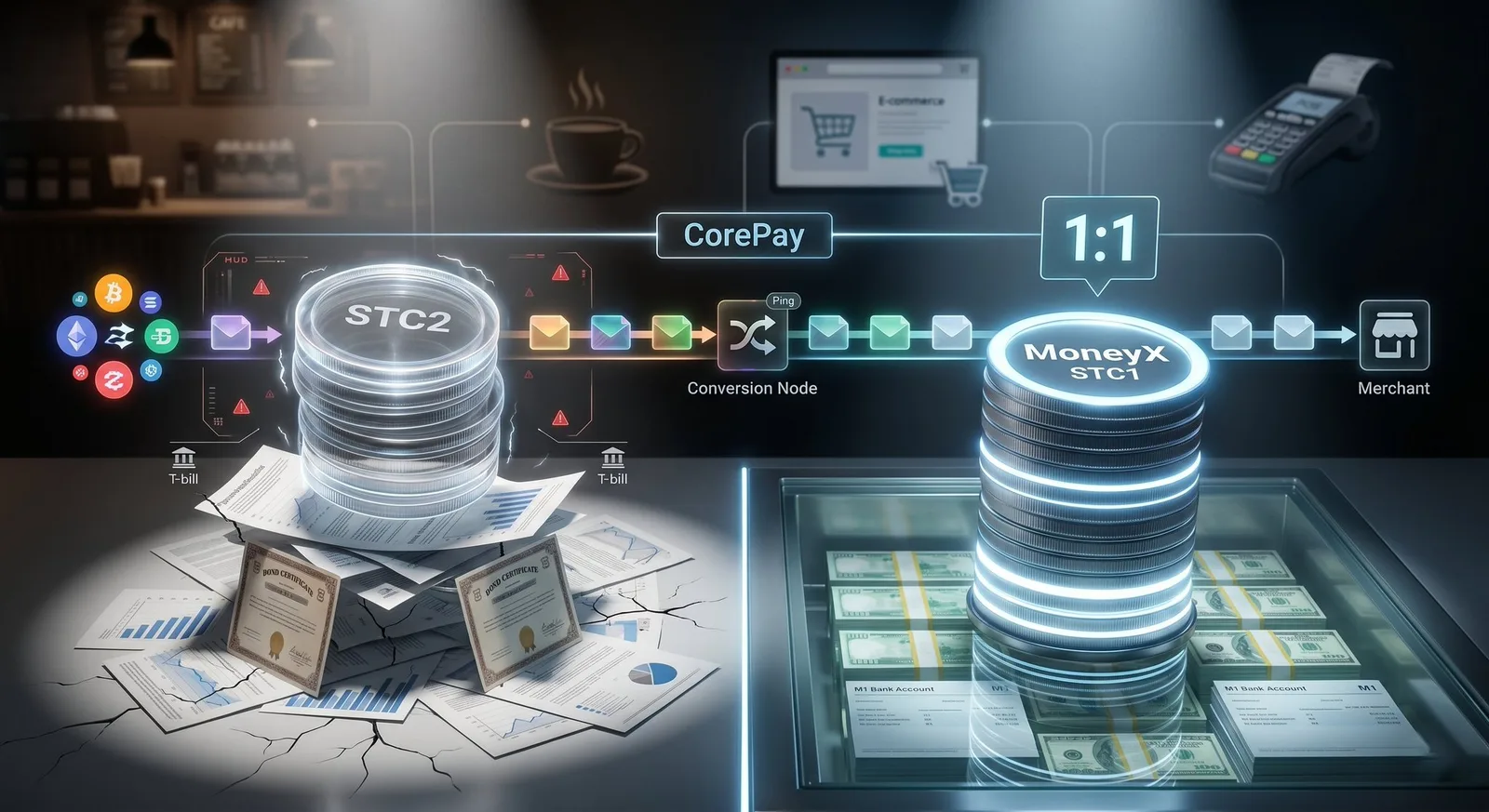
- MoneyX is a Stable Token Class 1 (STC1). That's not a label. It means the backing fiat sits in real M1 bank accounts and is never invested. USDT and USDC are Class 2 — their backing gets put to work in short-term instruments. The 1:1 peg is not the same thing.
- Three large partnerships are currently under NDA. The infrastructure for them has already been built.
- The marketing plan involves New to the Street appearances on Bloomberg, Fox News, ABC, NBC, NASDAQ and NYSE. The content is already recorded. The release is deliberate — it waits on the full ecosystem being live.
1. Why They Built a Stack, Not a Product
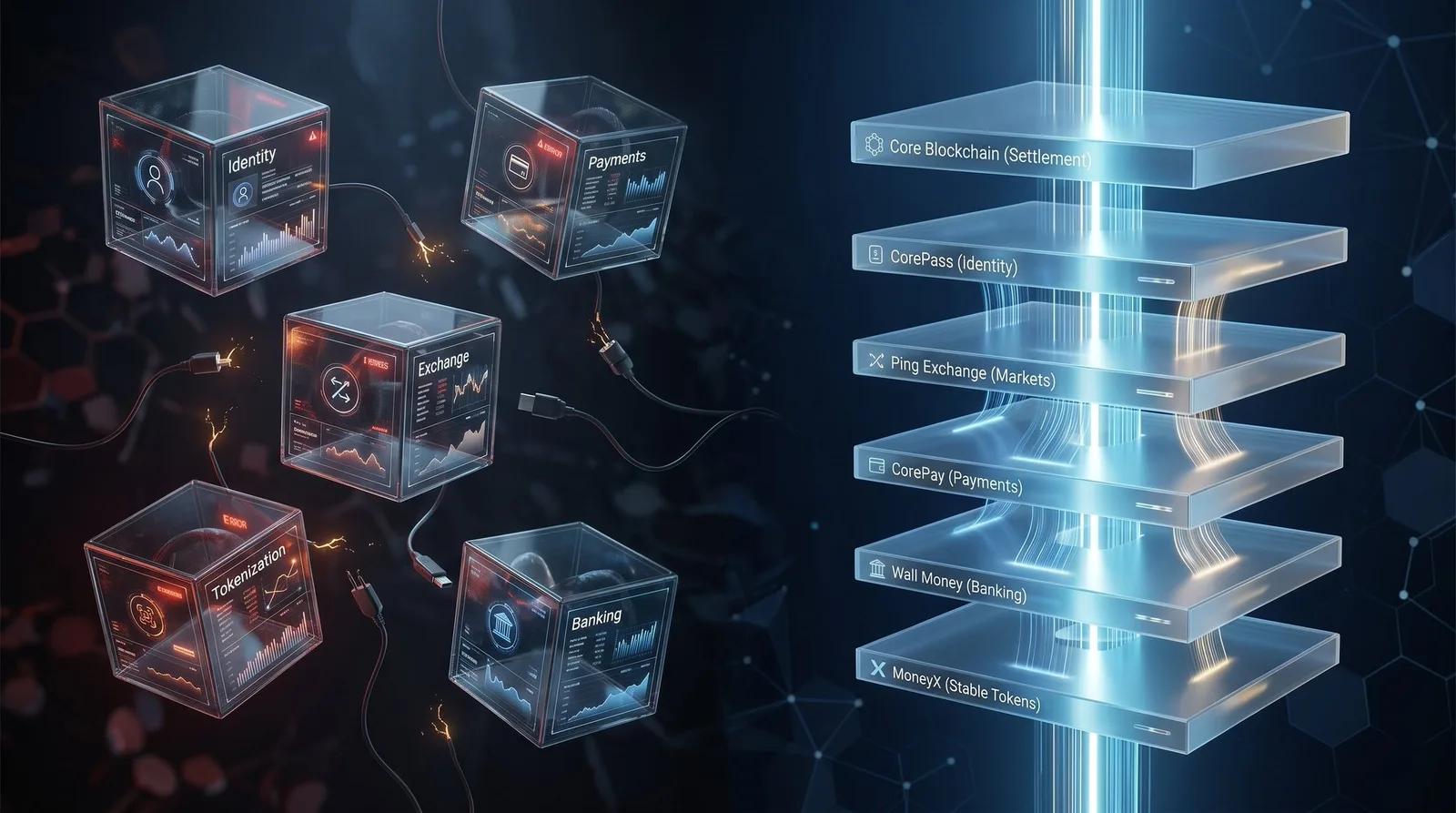
The first thing Okkie said — and repeated — is that the vision was never to build a product. It was to build infrastructure for a complete digital economy.
Most companies in the space solve one problem: identity, or payments, or exchange, or tokenization. Then they spend years trying to integrate with each other. Every connection is a seam. Every seam is a point where things break, slow down, or charge fees.
The CoDeTech approach was to design the layers so they share the same foundation from the start. Core Blockchain (XCB) handles the settlement ledger. CorePass handles identity, KYC, KYB and self-custodial wallets. Ping Exchange handles price discovery and market infrastructure. CorePay handles merchant payments. CorePort handles on-ramp and off-ramp flows. Wall Money handles banking. Luna°Mesh handles connectivity where traditional networks fail. The Core Settlement Network is the rail that moves value between all of them.
"The vision is not simply to build many products. The vision is to build the rails for trusted digital value transfer."
That architecture is what makes the CorePay announcement meaningfully different from a standalone payment app shipping a new feature.
2. CorePay Is Live
CorePay turns Ping Exchange into a payment gateway. Any user who has a verified CorePass account and is registered on Ping Exchange can generate payment links, HTML buttons and donation flows immediately — no merchant account application, no weeks-long approval cycle. The KYC was already done when the user registered their CorePass identity. That identity is the merchant credential.
The feature Okkie called out specifically: recurring payments in crypto. The ability to pause, resume and cancel recurring crypto payments from the user side. Subscription-style behavior, fully in the user's control, on-chain. It does not exist in the current crypto-payments landscape in this form.
Okkie used it himself the day of the AMA: "I did the first transaction. It was so cool."
A dedicated breakdown of how CorePay works is coming separately. The point here is simpler: it is live, it required no new credential for existing CorePass users, and Okkie treated it as the most personally significant thing he's shipped.
3. MoneyX Is Not Like Other Stablecoins
Most of the crypto space glosses over what it means for two stablecoins to peg to the same dollar. The backing is not the same thing.
Okkie introduced a classification: Stable Token Class 1 (STC1) versus Stable Token Class 2 (STC2).
USDT and USDC are Class 2. Their promise is a 1:1 peg to the dollar. In practice, the reserves backing them are not sitting idle in a bank account. They are invested — in short-term US Treasury bills, money-market funds, and historically, commercial paper and structured instruments. The backing exists, but it is being put to work. That creates basis risk. USDC de-pegged in March 2023 when Silicon Valley Bank collapsed with a portion of its reserves held there. USDC briefly traded as low as ~$0.87 before recovering. That's the basis risk that shows up when backing is invested rather than held.
MoneyX (USDX, EURX, and other denominations) is Class 1. The fiat backing goes into real M1 bank accounts — actual currency that is not invested, not lent out, not used for yield. One euro deposited mints one EURX. One EURX burned releases one euro back. The peg is not maintained by algorithmic arbitrage or collateralization ratios. It is maintained by the physical fact that the fiat is there.
Okkie: "That's why you will not see a fluctuation between a dollar and the USDX."
This matters for the Wall Money use case. When you tap a card backed by Wall Money, CorePort runs a market order on Ping Exchange, converts your asset into USDX, and the merchant receives the dollar equivalent. The settlement chain works precisely because USDX has no basis risk at the settlement layer.
4. Building in Silence
The most revealing part of the AMA was something Okkie kept returning to — a principle about timing that explains every public decision CoDeTech has made since 2022.
He put it directly:
"It doesn't help you excite someone and then say, come for a picnic and you can have everything. And then in the end, you only serve cupcakes, but not the full cake and the cherry and the champagne."
That logic runs through every public timing decision. The adoption numbers currently sit at approximately 15,000 CorePass users and 7,000 Ping Exchange accounts — deliberately organic, no paid campaigns while the platform completes its final layer rollouts.
The marketing plan itself is not hypothetical. New to the Street is an established financial media program with placements on Bloomberg, Fox News, ABC, NBC, NASDAQ and NYSE displays. Okkie said the content has been recorded. It has not been released. Not because it isn't ready — because the ecosystem isn't fully live yet.
Three large partnerships are also under strict NDA. Okkie was specific: the infrastructure for them has already been built. These are not letter-of-intent announcements. The disclosure timing is gated on Wall Money going live. His phrasing: "We are revolutionizing certain parts of certain industries which we haven't disclosed to anyone."
KYB is next after that. Know Your Business in CorePass structures every registered business as its own DAO — with ownership records, UBOs, voting rights, permission-based representative authorizations and verifiable signatures. A representative carrying a CorePass credential can be verified as actually representing their company, cryptographically, before signing a contract or entering a transaction.
The pattern Okkie describes — build the full infrastructure, then open the door — goes back further than CoDeTech. In 2003, he and his father built a payment system for rural funeral cooperatives in South Africa, running on GPRS and magstrip cards, before commercial POS terminals existed in those markets. They weren't waiting for the market to demand it. They built the system, then showed it to the people who needed it.
Twenty-three years later, the sequencing is the same. Build the rails. Build the settlement layer. Build the banking. Build the tokenization. Then release demand.
5. The Technical Baseline
For readers who want the protocol numbers: the Core Blockchain runs on ED-448 elliptic-curve cryptography — 224-bit security, a step above the secp256k1 standard used by most chains. Block time is 7 seconds, finality after 6 blocks = 42 seconds. The block reward is 5 XCB. Mining is CPU/IoT-based by design — IoT devices have algorithmic priority over larger machines, keeping the network distributed.
The Pigeon Protocol enables transaction batching: up to one million transactions can be grouped and settled in a single 42-second confirmation window.
One correction Okkie had to make during the Q&A: a community member confused the Core Blockchain (XCB, built by CoDeTech) with Core DAO (CORE token), which is an unrelated Bitcoin sidechain project. They are different projects with different architectures, different tokens and no shared codebase.
Bottom Line
Okkie spent 72 minutes in a Telegram voice chat answering questions from a community he'd never spoken to before. He corrected a wrong assumption directly, explained the MoneyX reserve model without softening, named the regulation challenges that delayed Wall Money, and estimated numbers instead of rounding up.
CorePay is live. Wall Money follows. The NDA partnerships announce when Wall Money does. The TV campaign runs when the stack is complete.
The cake is almost ready. The champagne is in the fridge. The cupcakes went live yesterday.