
Article
Groceries at a Lidl Checkout: What the Compressed Chronicles Actually Told Us
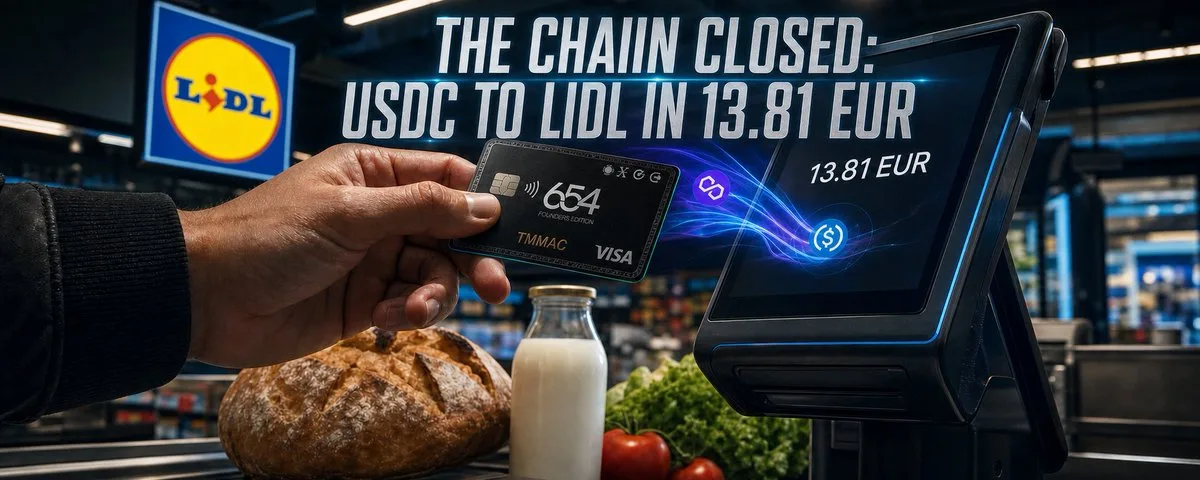
On July 14, the CEO of CoDeTech paid 13.81 EUR for groceries at a Slovakian self checkout with money that had been USDC on Polygon a minute earlier, and filmed the whole thing in one take. That clip closed a three part Compressed Chronicle series published between July 10 and July 14, and most of the community read those three parts as three separate updates. They belong together. One argument, delivered in three moves, and the third move is a grocery bill for 13.81 EUR.
Here is what Ockert Loubser actually said, what it means for the stack, and the honest answer to the question everyone is asking: which stage are we in right now?
1. The Series in One Paragraph
Part 1 (July 10): CorePass KYB enters official final testing, and MoneyX commits to monthly signed or notarized reserve reports. Part 2 (July 12): MoneyX STC1 gets its target audience, the MoneyX Alliance is introduced as a minting channel, and Wall Money enters official final testing. Part 3 (July 14): Okkie and Rastislav walk into a supermarket and pay for groceries with money that started as USDC on Polygon inside CorePass.
Part 1 ends mid sentence. Part 2 picks up the exact same sentence. That is one continuous statement, cut into three shorts.
2. CorePass KYB: The Boring Feature That Is Actually the Big One
The headline from Part 1 is a status change: "CorePass KYB is no longer just something we are talking about. It is moving into the real use. We are starting the official final testing of CorePass KYB."
The feature that shipped alongside it sounds like housekeeping and is not. It is push notifications: team members now get notified when a business team is created, and when a decision needs review and approval.
Why that matters is in Okkie's own framing: "Business verification is not only about documents. It is also about who represents the business, who has authority, and how important actions are approved."
Remember what the KYB first look demo in early July showed: a business wallet that only goes live once every voting member has signed the registration proposal, with governance configurable per action category (asset management, platform connections, signature requests, data requests, verification procedures, structural changes). The approval gate existed. What did not exist was a reliable way to tell the humans that they were being asked to approve something. A multi signature governance model where nobody knows a signature is pending is a governance model on paper only.
So the sequence for CorePass KYB now reads: infrastructure deployed and internal testing announced (June 19), real UI shown (July 3), official final testing (July 10). Three steps in three weeks.
One thing to keep straight: final testing is not a public release. No date was given, and none should be invented.
3. MoneyX: A Transparency Commitment With a Frequency Attached
Part 1's second announcement is the one institutional readers should care about most. Every MoneyX stabletoken is backed 1:1 by real fiat, and MoneyX will publish monthly digitally signed or notarized reserve reports confirming the fiat balances in the banking accounts where the reserves are custodied.
Okkie's phrasing was blunt: "Not paper claims, not promises, real backing."
The reason this lands differently than the usual attestation talk is the combination of three properties in one sentence: a fixed frequency (monthly), a verifiable form (digitally signed or notarized), and a named object (the fiat balance on the custody bank account). Most of the market gives you one of those three, quarterly, in PDF form, with a scope disclaimer.
Part 2 then sets the perimeter. STC1 is designed for retail customers, businesses, institutions, and "future CBDC interoperability where applicable." And minting is opened up: "Minting services will also be available through the MoneyX Alliance for both small and large issuance requirements. So, if you want to be part of the next generation of digital finance and the growing neocurrency movement, this is your invitation."
Read that last line again. That is a stabletoken issuer publicly inviting third parties to issue through its rails. It reframes MoneyX from a product inside the stack into a service the stack sells outward.
4. The Word "Backed" Has Been Quietly Redefined
Ask most people what backs the two largest stablecoins and they will say dollars. That has not been true for years.
Take Tether first. According to the Q1 2026 quarterly attestation by BDO Italia, roughly 80% of reserves sit in US Treasury bills, directly or via money market funds and repo. The rest is spread across secured loans (about 4 to 6%), Bitcoin (about 4 to 5%), and gold (about 3 to 4%). Cash itself is a small residual line. Those figures come from Tether's own published breakdown. And it is worth remembering how the industry learned to read these numbers carefully: in 2021 the CFTC found that Tether had claimed USDT was fully backed by US dollars during a period when reserves included unsecured receivables and non-cash assets.
Circle is cleaner, and still not what people picture. The USDC reserve targets roughly 80% short dated Treasuries and 20% cash, with the majority held in the Circle Reserve Fund, an SEC registered government money market fund managed by BlackRock. Circle publishes monthly reports from Deloitte, and Circle itself is precise about what those reports are: "An attestation provides assurance around a specific statement or criteria, while an audit is specifically used to provide assurance around financial statements." Attestations are agreed upon procedures. They are not audits.
We spent a full podcast episode on this back in June 2025, Episode 23, "Stable Coin vs Stable Token", asking a question we could not answer at the time: is the coverage behind USDT and USDC really guaranteed, and who exactly gets to confirm it. A year later the issuers' own numbers answer it, and the answer is the paragraph above. We have walked through the same arithmetic in "The Mathematics of a Bank" and "The $100 Trillion Illusion", and it has not improved since. So the honest summary of the market leaders is this: they are fully collateralized by a portfolio of financial instruments, verified by procedures agreed with the issuer, on assets held mostly in funds rather than as cash in a bank. Every one of those words is doing work.
Now put Okkie's STC framework next to it. He has been drawing this line publicly since at least the Whale Sailors AMA in June, where he classified MoneyX as Stable Token Class 1 and USDT and USDC as Class 2. His distinction is one sentence long: the M1 accounts hold the real fiat 1:1 and it does not get invested, while Class 2 issuers invest the backing, which means there is no true 1:1 parity behind the token.
That is a structural difference, not a marketing one. A Class 2 stablecoin carries duration risk, counterparty risk on the fund and the repo, and mark to market risk on whatever else is in the bucket. A Class 1 stabletoken concentrates the risk on one question instead: is the cash really sitting at the bank, and is that bank sound.
Which raises the obvious question: if holding uninvested cash is safer, why does nobody do it?
Because it is expensive. A treasury portfolio backing tens of billions in circulating supply generates enormous interest income, and for the largest issuers that income is the business model. Uninvested fiat earns the issuer nothing. Choosing Class 1 means giving up the revenue that makes Class 2 attractive to operate, which is exactly why the market converged on Class 2 and then redefined "backed" to make it sound like the same thing.
CoDeTech is going the other way on purpose. USDX and EURX are designed so the fiat sits still, and the promised monthly report is meant to prove it is still sitting there. Combined with the on chain proof of ownership approach Okkie has described, the goal is a token whose backing you can check rather than one whose backing you are asked to accept.
And that is the part worth saying plainly. Every major issuer in this market faced the same choice and made it the same way: keep the yield, put the reserve to work, and write the consequences into a disclosure that almost nobody reads. MoneyX is the first to make the opposite choice a design principle rather than a footnote. The fiat stays put, the yield is given up, and the word "backed" goes back to meaning what people always assumed it meant.
5. Wall Money: From Feature List to Grocery Receipt
Part 2 puts Wall Money into official final testing "in preparation for the launch," covering proofreading, transactions, conversions, payments, transfers, swapping, connecting and security testing. Then Okkie does something the industry almost never does: instead of ending on the feature list, he says "for that part, I think we should not just talk about it. Rastislav and I are going shopping."
Part 3 is that shopping trip, filmed in one continuous handheld take at a self checkout in Slovakia. Two phones, deliberately, so the chain stays visible:
| Step | What happens | Visible |
|---|---|---|
| 1 | 50 USDC on Polygon sent from CorePass via QR scan | Phone 1 |
| 2 | Funds land in the Wall Money wallet, balance 96 USDC | Phone 2 |
| 3 | Transfer and off ramp from wallet into the USD account, 50 USDC to 50 USD | Phone 2 |
| 4 | Payment at the self checkout with the virtual card, double tap on the phone | At the till |
| 5 | The booked transaction appears in the account history, merchant Lidl, exact store | Phone 2 |
The bill was 13.81 EUR. His colleague's was 0.12 EUR, which the video puts on screen as a joke and which is also the tell that nothing here was staged for a demo budget.
Okkie's closing line is four words: "Wall Money is working."
The official description is more precise about what was proven: "This is not theory. This is not a diagram. This is not a coming soon promise."
Step 4 is the hard one. Anyone can move a token between two wallets. Getting value out of a chain, into a fiat account, onto a card, and through a point of sale terminal in a supermarket is where most crypto payment stories quietly end. That step is now on video, end to end, unedited.
6. So Which Stage Are We In?
Here is the honest map. Five stages, and the boundary matters.
Stage 1, whitepaper. Passed years ago. Stage 2, diagram. The stack drawn as boxes and arrows. Passed. Stage 3, working UI. The KYB first look on July 3, the Wall Money click through before it. Passed. Stage 4, end to end proof under real world conditions. A real merchant, real card rails, real money, no simulation. This is where the July 14 video puts us. Stage 5, public availability. Open signup, published fees, documented limits, a launch date.
We are at the end of stage 4 and not yet in stage 5. That distinction is the entire point of this article, because it cuts both ways.
Against the sceptics: the off ramp and card acceptance question is settled. It has moved from promise to footage, with a merchant name in the transaction history.
Against our own impatience: no launch date was given, and the word "launch" does not appear in the demo at all. No fees, no exchange rates, no limits, no public registration were mentioned. Both Wall Money and CorePass KYB are described as being in final testing, which is the stage right before release and is not release.
If anyone in the community tells you Wall Money is live, they are ahead of the sources. If anyone tells you it is still vapourware, they are behind the sources. Both statements are wrong for opposite reasons, and that gap is where we live right now.
7. Why This Series Matters More Than a Launch Post
Look at what the three parts do together. Part 1 puts identity into final testing. Part 2 puts money and its proof of backing into final testing and opens issuance to partners. Part 3 spends that money in a shop.
Identity, settlement, and point of sale, in five days, in the same order the stack was architected in. Not one product getting a marketing push. A vertical slice through the whole system, demonstrated with real transactions.
For eleven years this ecosystem built the layers in the wrong order for hype and the right order for infrastructure: chain first, identity second, rails third, consumer surface last. The consumer surface is the part people can finally see. That is what changed in July, and that is what makes this series worth understanding rather than just liking.
This is what the Web4 argument has always come down to for us: identity, settlement and connectivity working as one system, all the way to a card terminal in a supermarket, rather than another chain competing on block times. We have made that case in "Why 2026 Is Not a Hype Year for CORE" and in every article since. July is the first month where the case stopped being architectural and started being observable.
The question is no longer whether the chain from crypto to a checkout terminal closes. We watched it close. The question is who is ready to use it the day stage 5 arrives.