
Explainer
Core Blockchain, Core DAO, Core Wallet: Three Projects, One Name
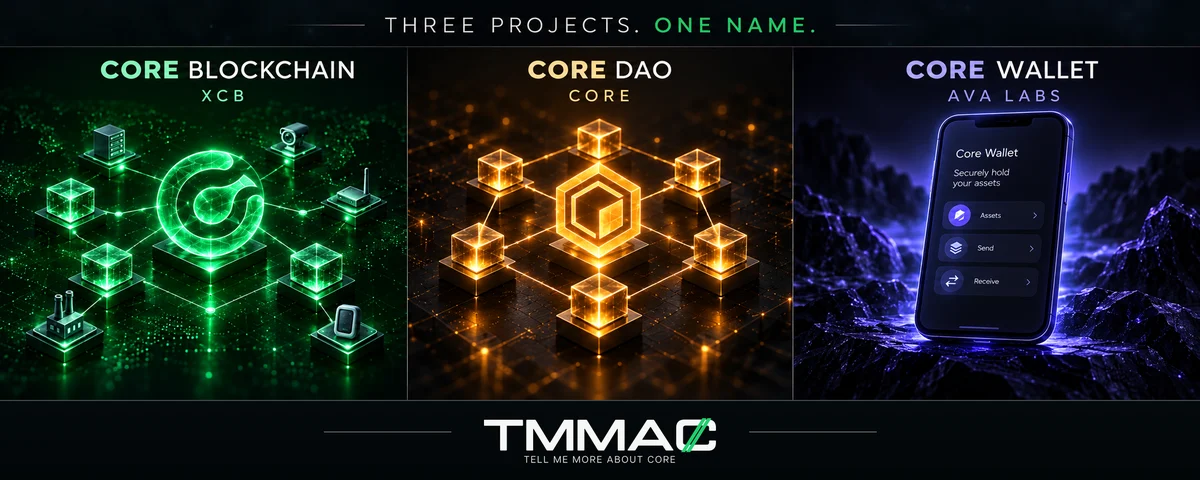
Three different projects go by the name Core. Core Blockchain is the network behind the XCB coin, live since May 2022. Core DAO is a separate EVM-compatible network with its own token, CORE, launched in January 2023. Core by Ava Labs is a wallet, not a blockchain. Three separate projects, three different teams.
That overlap is not just casual shorthand. Core DAO's own documentation calls its network "The Core Blockchain", which is also the everyday name of the network behind XCB. So if you search for "Core blockchain", read a price page or ask an AI assistant, it is easy to end up with the wrong project. This page lays the three side by side.
At a glance
| Core Blockchain | Core DAO | Core (wallet) | |
|---|---|---|---|
| What it is | Layer-1 blockchain | Layer-1 blockchain | Crypto wallet |
| Native asset | XCB (Core Coin) | CORE | none |
| Consensus | PoDE, a green evolution of Proof of Work (RandomY algorithm) | Satoshi Plus (DPoW + Bitcoin staking + DPoS) | not a chain |
| Address format | ICAN, mainnet prefix cb | Ethereum-style 0x | depends on the network |
| Mainnet | 7 May 2022 | January 2023 | — |
| Made by | CoDeTech ecosystem | Core DAO | Ava Labs |
| Website | coreblockchain.net | coredao.org | core.app |
Which came first?
Core Blockchain. Its mainnet went live on 7 May 2022, eight months before Core DAO's mainnet in January 2023. The team goes back further still: according to Core's own timeline, its three founders started working together on 1 December 2013. So when the two chains get mixed up, it is usually the older one that gets overlooked.
Core Blockchain (XCB)
Core Blockchain is the network this site is about. Its mainnet went live on 7 May 2022, and it sits at the base of the CoDeTech ecosystem. Its native currency is XCB, the Core Coin. The ecosystem also has a second asset, CTN, the Core Token.
Three technical choices set it apart from most chains:
- Green Proof of Work. Core Blockchain runs on Proof of Distributed Efficiency (PoDE), an eco-friendly evolution of Proof of Work. Its mining algorithm, RandomY, is derived from RandomX and retuned for small IoT devices and ARM processors. No special mining hardware is needed: a laptop, a small ARM board or even a phone can mine. We explain the energy side in Blockchain doesn't have to kill the planet.
- Ed448 signatures. Instead of the secp256k1 curve used by Bitcoin and Ethereum, Core signs transactions with Ed448 (CIP-98).
- ICAN addresses. Addresses follow the International Crypto Account Number standard (CIP-100). They borrow the structure of a bank IBAN: a network prefix, then a two-digit checksum computed the same way as an IBAN's, then the account part. Mainnet addresses start with
cb. The checksum is there to catch typing errors before any money moves.
Core DAO (CORE)
Core DAO describes its chain as "a high-performance, EVM-compatible Layer-1 blockchain, designed to be Bitcoin's complementary and hyper-scalable smart contract platform". It launched its mainnet in January 2023.
Its consensus is called Satoshi Plus, which in its own words "integrates Delegated Proof of Work (DPoW), Self-Custodial Bitcoin Staking, and Delegated Proof of Stake (DPoS)". Its native asset is CORE. Core DAO calls it a token, but CORE pays the gas on Core DAO's own chain. In the usual sense of the words, that makes it the chain's native coin, the same role XCB plays on Core Blockchain. CORE is also used for staking and governance. Because the chain is EVM-compatible, it uses Ethereum-style 0x addresses and connects to wallets like MetaMask under chain ID 1116.
Core DAO is not part of the CoDeTech ecosystem, and CORE is not XCB.
Core by Ava Labs (wallet)
The third Core is not a blockchain at all. Core is a wallet made by Ava Labs, the company behind Avalanche. In its documentation it is described as "a non-custodial crypto wallet for managing digital assets and using decentralized applications across Avalanche (C, X, and P-Chains), Ethereum, Bitcoin, Solana, and EVM networks generally". It comes as a browser extension and as a mobile app.
It has no chain and no token of its own. When people say "Core" in an Avalanche context, this is usually what they mean.
How to tell them apart in practice
- The ticker. XCB means Core Blockchain. CORE means Core DAO. The wallet has no ticker.
- The domain. coreblockchain.net, coredao.org and core.app belong to three different teams.
- The address. An address starting with
cbis a Core Blockchain mainnet address. One starting with0xis not, whatever it is labelled. - The context. Talk of Bitcoin staking points to Core DAO. Talk of Avalanche points to the wallet. Talk of ICAN, CorePass or CPU mining points to Core Blockchain.
When in doubt, check the ticker before you trust a price, and check the address prefix before you send anything.
Frequently asked questions
Is Core DAO the same as Core Blockchain?
No. Core Blockchain is the network behind the XCB coin, live since May 2022 and part of the CoDeTech ecosystem. Core DAO is a separate EVM-compatible network with its own token, CORE, launched in January 2023 and secured by its Satoshi Plus consensus. They are separate projects with different teams, chains and tokens.
Which Core came first?
Core Blockchain. Its mainnet went live on 7 May 2022, eight months before Core DAO's mainnet in January 2023. The team behind Core Blockchain has worked together since December 2013.
Which Core is XCB?
XCB (Core Coin) is the native currency of Core Blockchain (coreblockchain.net). It is mined under Proof of Distributed Efficiency (PoDE), the green evolution of Proof of Work, with the RandomY algorithm: a derivative of RandomX tuned for small IoT devices and ARM processors. XCB is not the CORE token of Core DAO.
Is the Avalanche Core wallet a blockchain?
No. Core by Ava Labs is a non-custodial crypto wallet, available as a browser extension and a mobile app. It manages assets on Avalanche, Ethereum, Bitcoin, Solana and other EVM networks. It has no blockchain and no token of its own.
Can I send XCB to a Core DAO address?
No. The two networks use different address formats. A Core Blockchain mainnet address is an ICAN address that starts with cb and carries a checksum. Core DAO uses Ethereum-style addresses that start with 0x. Always check which network an address belongs to before sending.
How do I know which Core a price page or article means?
Look at the ticker and the domain. XCB and coreblockchain.net mean Core Blockchain. CORE and coredao.org mean Core DAO. core.app and Ava Labs mean the wallet.
Sources
Every claim above was checked against the sources below on 23 September 2026. Each project is described from its own documentation.
- Core Blockchain mainnet launch on 7 May 2022: Core Blockchain Mainnet is Live, Core blog, 7 May 2022.
- Founders working together since 1 December 2013, PoDE as an upscaled, eco-friendly Proof of Work, mining without special devices: Core Blockchain Web 4.0, Core blog, 2022.
- XCB (Core Coin), CTN (Core Token), mining algorithm RandomY: coreblockchain.net, checked 23 September 2026.
- RandomY derived from RandomX, optimised for IoT CPUs, ARMv7 and ARMv8 support: core-coin/RandomY, README.
- Ed448 signatures: CIP-98, Core Cryptography Scheme.
- ICAN addresses, IBAN-style checksum, mainnet prefix cb: CIP-100, ICAN.
- Core DAO as an EVM-compatible Layer-1 and the title "The Core Blockchain": Core DAO documentation, introduction.
- Satoshi Plus consensus: Core DAO documentation, architecture.
- CORE as the gas token of Core DAO's chain: Core DAO documentation, CORE token overview.
- Core DAO mainnet launch in January 2023: Core First Year, Core DAO blog.
- Chain ID 1116: Core DAO documentation, network configuration.
- Core as a non-custodial wallet by Ava Labs, supported networks, browser extension and mobile app: Core documentation and core.app.