
Article
Cards, Stabletokens and a Bank: Everything Okkie Told the Crypto Panda AMA
On 24 June, Ockert Loubser sat down with Crypto Panda for an hour on Binance Live. No slides, no script. Just sixty minutes of the CoDeTech CEO walking through what the team has built and answering whatever the room threw at him.
If you missed it, here is the whole thing in one place. Key points, the exact moments that matter, and an honest line on what is actually live today versus what is still coming.
1. "We are not a crypto company"
Okkie set the frame early, and he kept returning to it. "We're in actual fact a technology company that has built rails," he said. "Real rails for the digital world."
The pitch is end-to-end, not single-product. Mining, identity, exchange, commerce, settlement, and real-world spending, all in one stack. He calls it the transfer of value rather than the transfer of currency. Value can be money, but it can also be identity, data, ownership, a commodity, or an access right.
His diagnosis of the industry was blunt: the space is fragmented. One project gives you a chain. Another gives you a wallet, or an identity, or tokenization. "We wanted to solve the entire journey, not just one part." That is the thesis behind every product below.
2. The moment they said our name
Partway through, Okkie made his point about infrastructure over hype, and then he reached for an example. Ours.
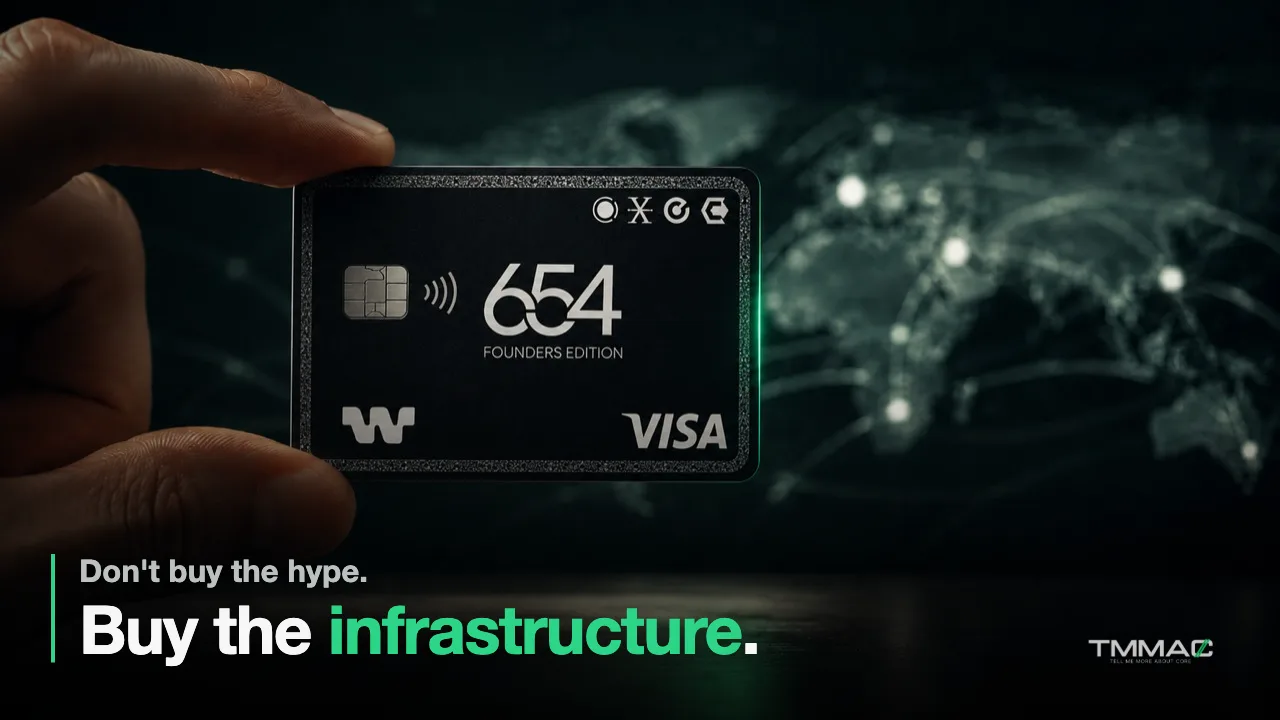
"A very interesting platform, TMMAC, tell me more about Core, says don't invest in the coin, invest in the infrastructure. Because that's what you're truly buying."
That is the CoDeTech CEO quoting TMMAC by name, on Binance Live, to make his own argument. We did not ask for it and we did not plan it. It is a reminder of why this channel exists: to explain the infrastructure clearly enough that the framing travels on its own.
3. The card and the bank
This was the most tangible part of the AMA, because Okkie held the cards up to the camera. A UnionPay card. A Visa card. His CoreID. "These are real bank cards. Real, real bank cards."
The mechanism: your CorePass wallet connects to a bank account, and any card can become what he calls a crypto card. You do not deposit your Bitcoin or your USDC anywhere. The assets stay in your wallet, and the card draws against them with a spend hierarchy you control. Stable tokens first, then other assets, then commodity or RWA tokens. "If you can prove you own the tokens, you can spend it."
He described the bank behind it as "the world's first hybrid self-custodial bank." Self-custodial is the operative word: you keep the assets, the bank never holds them. That single design choice is what sets it apart from every neobank wearing a crypto badge. The economics he quoted: a maximum fee of two and a half percent, against the seven to fifteen percent he says other platforms charge. And the trade engine runs on real market orders, "no bots, no market makers, no fake liquidity." That is also why, by his own choice, you will not find the coin on CoinMarketCap.
4. Stabletokens vs stablecoins
Okkie drew a line most projects never draw, between his stabletokens and the stablecoins everyone already holds.
He calls his an STC, a Stable Token Class. The mass-market stablecoins, USDC and USDT, he puts in a separate bucket: "They don't have the physical one to one. They've invested into Bitcoin, junk bonds, all kinds of things."
His own version runs on the MoneyX platform with M1 accounts. "Every token that's minted is through a deposit that's made into the bank account. If it is a dollar, there's one token." The minting is automated, the smart-contract audit is automated, and the float against the bank balance is meant to be visible at any moment. An M1 account, he stressed, has to stay liquid and cannot be invested by the bank. That is the whole point.
This is not a new product reveal. We described MoneyX as a Class 1 stabletoken back in April. What was new was hearing the CEO put the one-to-one claim, and the contrast with USDC and USDT, this directly on a live stage.
5. Tokenized commerce, through Shopify
Ask Okkie how he plans to win merchants, and he goes to commerce infrastructure rather than incentives. "I actually already built a Shopify plugin and connector," he said. His number: "90% of all New York shops use Shopify as their storefront."
The plugin is called ARK. A merchant pushes one CSV file, and it builds the full Shopify listing automatically: images, stock, the lot. Then the part that matters for this ecosystem. "One click and you tokenize it."
When a customer buys, they can take a digital certificate or a token of the product, minted on the spot and linked to the payment. That becomes a Digital Product Passport: a full audit trail of where the item was made, the materials, the images. His example was sharp. Nike just suffered a major data breach, and leaked product specs make one-to-one "superfakes" possible. A DPP is how a brand and a buyer prove the real item is real. He also flagged the EU G7 circular-economy rules pushing the same direction, with a dry warning that "if Europe continues this way, they're going to regulate themselves out of business."
6. A DAO inside the wallet
A genuinely fresh detail landed late in the hour. CoDeTech is releasing KYB, which Okkie described as "the first digital wallet that does a full KYB with a full DAO mechanism."
Inside that business wallet: voting rights, permission controls, access controls, transfer roles, and asset holding. This is CorePass moving from the individual layer to the organizational one, and it lines up with the KYB work the team flagged in the Compressed Chronicle on 19 June. Businesses, not just people, get a verified on-chain identity with governance built in.
7. Ping, and a bank that is "very close"
On the exchange, Okkie described Ping Exchange as "four exchanges in one": stocks, commodities, digital assets, and digital forex. No market makers, driven by the community that uses it.
Then the line worth marking carefully: "We are about to release the bank. This is not live just yet. It is coming live now very, very, very shortly. We are extremely close." He says the cards are already being tested for payments across jurisdictions, which is why he had them in hand. More on the "not live yet" part below.
8. The network that works without internet
Luna Mesh got its own deep section, and Okkie was clear it is more than free Wi-Fi. "It's a real DePIN." A physical network of devices that can operate with no external connectivity at all.
His favorite illustration is epidemic routing. Two trucks in the middle of the Sahara, no cell network, no GPS, each carrying a node. They pass each other, exchange data, carry it onward, and sync when they next hit connectivity. On top of that: blockchain transactions over SMS, on-chain, with no internet. And a proprietary protocol that streams across four frequency ranges at once, "which makes it almost impossible for jamming." He even claimed they have made "UFOs of drones" on the mesh, and left it there.
9. What keeps him up at night
Asked for the real risk, Okkie did not name a competitor or the market. "What keeps me awake at night is the regulators." Rules can change in under two weeks, and the team has to adapt each time.
His answer to that is built into the stack: programmable compliance. Identity, AML, and the rules sit inside the transaction flow rather than getting checked after the fact. He framed inclusion as the goal, naming rural areas, excluded communities, and prohibited jurisdictions. For the record, he stated the regulated footprint plainly: "a Swiss regulated exchange and an Asian regulated bank."
One honest caveat
This is the part to keep straight. A lot of what Okkie showed is in final testing, not in your hands yet. He said it himself about the bank: "This is not live just yet." Wall Money is "going live very shortly," and the stabletoken is still in testing and validation.
What he did say is live: CorePay and PayTo, including the WooCommerce plugin. The Wall Money cards are in pre-sale at wallmoney.store/ref/6/, where the six-month sale has ended. He flagged the rarest tier, the "654s," with a real scarcity hook: only 654 will ever exist, "never again," and they come with stock in the company. Treat everything else as close, but verify before you treat it as shipped.
If the "not yet" frustrates you, Okkie got there first. Asked why things take so long, he was blunt about who wants this live the most. "If there are three people that want this platform more live, more ready, more running, it's Michael, myself, and Rastislav. There are not three more people that are more motivated to get our platform out in the market. And we're not holding back because we want to." The delay is not a lack of will. It is regulators, banking partners, and approvals that move on their own clock, not his.
Read between the lines
The most interesting part of this AMA was not what Okkie confirmed. It was what he deliberately left open. He kept gesturing at things he could not say yet, and if you were listening closely, the direction was hard to miss.
"The world is not ready for what we have," he said. "What we have in our kitty and in our development, we can't release some of this stuff because it's not ready. People are not ready for what's about to come." Later, on the contracts the team is signing: "I can't talk about it because I'm under very, very strict confidentiality." And in closing: "There are things that are going to happen in this place where we are going to revolutionize stuff that people won't even see coming."
Read that the way it was meant. The cards, the bank, the stabletoken and the commerce stack are the part he can show. The hints point at something bigger sitting behind them: partners, agreements, and reach that he is not allowed to name yet. Attentive listeners already know roughly where this is heading. The rest will find out when the confidentiality lifts.
He also put the timing in plain sight. "There are very few people that know about us. We're now only starting with the marketing." He talked about "huge marketing campaigns coming," which lines up with the Bloomberg, Nasdaq and Fox airings he has mentioned in earlier AMAs. The product has been built quietly for years. The part where the rest of the world hears about it has barely started.
Bottom line
The through-line of this AMA was patience. "Hype may attract attention. Utility is what gives people a reason to remain." Okkie closed with an invitation to "come and swim upstream with us," and a line that sums up the whole approach:
"Success is when the technology becomes so practical, secure and integrated that people no longer need to talk about it at all. When trust becomes invisible, adoption becomes inevitable."
If you want the primary source, the full replay is on Binance Live. Watch the card segment, and the infrastructure point where the CoDeTech CEO made our case for us.
FAQ
Q: Is the Wall Money bank live yet? No. Okkie said it plainly: "This is not live just yet... we are extremely close." What is live today is CorePay and PayTo, including the WooCommerce plugin. The bank, the Wall Money cards and the stabletoken are still in testing.
Q: What is an STC, and how is it different from USDC or USDT? It stands for Stable Token Class. Okkie's version runs on MoneyX with M1 accounts: one fiat deposit mints one token, and the account stays liquid and cannot be invested. He puts USDC and USDT in a separate bucket, arguing they lack a true one-to-one backing.
Q: What are the "654s"? The rarest Wall Money card tier. Only 654 will ever exist, "never again," and they come with stock in the company. They are part of the pre-sale at wallmoney.store.
Q: Where can I watch the full AMA? The full replay is on Binance Live, hosted by Crypto Panda, recorded 24 June 2026.