
Article
The CEO Bought an Ice Cream: Two Okkie AMAs in 48 Hours
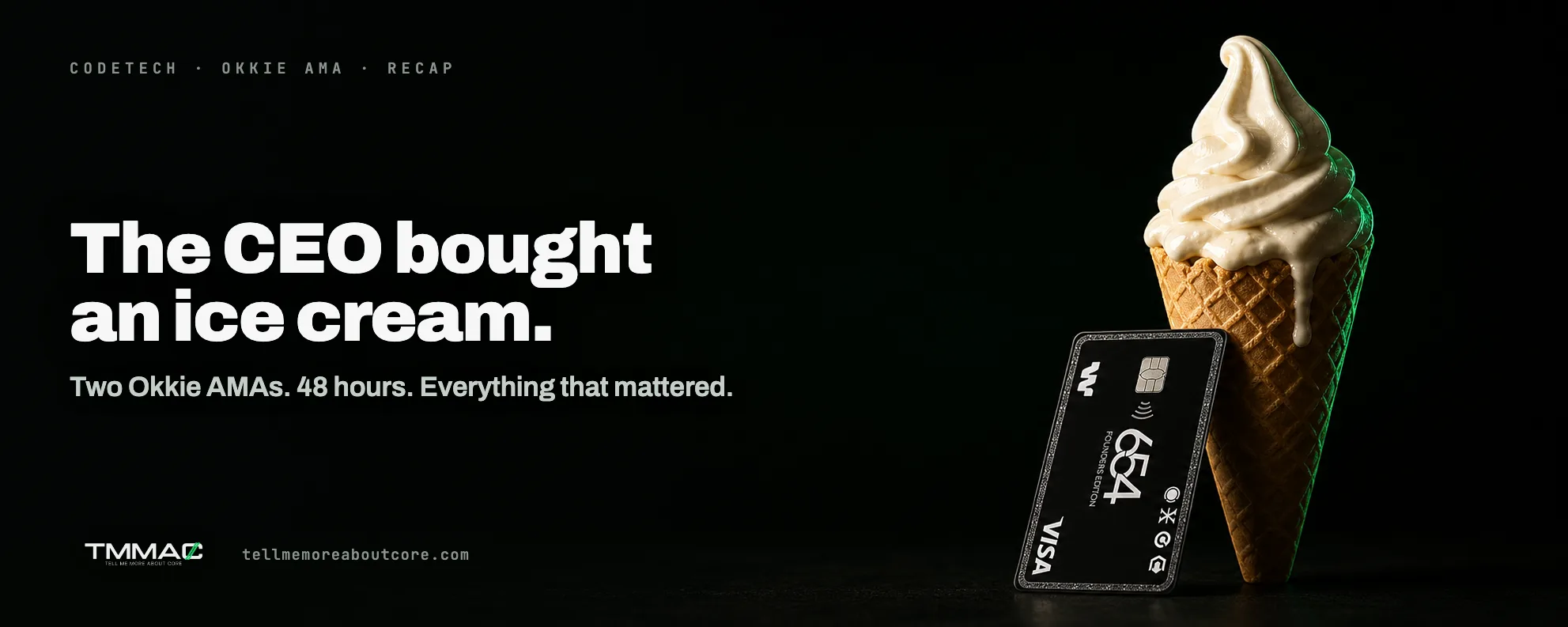
Between 6 and 7 July, Ockert Loubser went live twice. First a 46-minute Telegram audio AMA with the Crypto Alpha Grid community, then, less than 48 hours later, a 76-minute Space on X hosted by Crypto Infinity. Two rooms, two days, no slides.
If you follow this series, you know the standard tour: the rails thesis, the stack walkthrough, the self-custody argument. Both sessions delivered it. But between them they carried real new material: a purchase of ice cream, two dates worth writing down, a named identity partner, and the first mechanical explanation of a claim this channel has repeated for months. Here is what matters, pulled from both.
1. He bought an ice cream with it
The most important thirty seconds of the first AMA were about dessert. Asked who the platform is for, Okkie answered with a story from his own weekend:
"I did that this weekend. This exact thing. [...] I just bought an ice cream with it, with my bank card. Because we issue bank cards, we issue bank accounts, we have the full exchange."
He says a video of it is coming. Until that video is out, treat it as the CEO's own account rather than a public demo. But note what the claim actually is: mine a coin, walk into a shop, pay with a card. Not a testnet transaction, not a partnership announcement. An ice cream. For a project that has spent months saying the boring word "infrastructure" while others chase narratives, a working card at a shop counter is exactly the kind of proof that matters.
2. Two dates: Wednesday and Friday
Two concrete deadlines came up, and both AMAs repeated them.
First, the competition running on Ping Exchange closes today, Wednesday 8 July, at 4 p.m. CEST. Okkie gave the time himself in the Telegram session: "4 p.m. Central European Time." The stakes, in his words: 23 prizes, with the top prize at 2,000 dollars. "You get the USDC. You don't get Core coin or Core token. We're not giving those away, they're too valuable." Beyond the cash there are banking accounts for an entire year, with all services paid. You have to onboard to participate, which is the whole point: the competition is an excuse to get you through the digital-identity flow once.
Second, KYB. "The KYB will also be released very shortly. I will have another update probably on Friday to our community about it," he said, adding that things are getting "very, very hot and spicy in that area." He repeated the Friday timing in the X Space a day later. It lines up with the KYB first-look demo that surfaced on 3 July showing the four-step business registration wizard. CorePort, the on-ramp and settlement flow, "will be released soon" as well.
3. New letters: EURX and CHFX
Listing what a Wall Money account can hold, Okkie dropped two names we had not heard before:
"Or it's our own stables, which is USDX. We've got EURX, we've got CHFX. We've got multiple different currencies."
Until now, public talk of the MoneyX stable-token platform centered on the dollar. This is the first mention of euro and Swiss-franc stable tokens sitting alongside USDX. The mechanics stay the same as described in earlier sessions: an STC1, a Stable Token Class 1, where every token is minted against a real deposit in an M1 bank account, which he clarified in the second AMA is technically a "money call account," fiat on call at any moment. "For every one dollar, you have one token. That money doesn't move." If the fiat leaves the account, the tokens get burnt. MoneyX itself, he said, is "in its final stages."
4. They said our name. Again.
Asked where newcomers can learn the system, Okkie gave his answer in three parts: the Ping Exchange education hub, the CoDeTech YouTube channel, and this:
"There is tellmemoreaboutcore.com, which they have some really cool tutorials and things that they're doing. TMMAC is doing a great job at trying to explain the whole system. They're busy building also a full, let's say, knowledge base or official education portal where you can educate yourself inside the system."
That is the fourth AMA in a row where the CoDeTech CEO has pointed to TMMAC by name. We keep including these moments not to pat ourselves on the back, but because they document something real: this ecosystem is building its education layer in the open, and people are noticing. The portal he mentioned is in active development. He was not supposed to announce it before we did, but we will take it.
5. The origin story grew new chapters
Every AMA gets the founding story. The Telegram session added details we had not heard on record before.
The 2003 closed-loop banking system his father and he built for the South African funeral industry, on POS devices over GPRS, is apparently still in production: "That project today is still running exactly as it is. Even with the spelling mistakes that are still in the platform after we sold it off."
The lineage of the commerce product finally got named end to end: it started as TV Mall, a payment-splitting app for Tizen smart TVs, became Toktoki, and is today ARK, the tokenized-commerce plugin. The digital identity has a similar arc: a system called OneProfile, built in 2006, "which is now today CorePass." In the X Space he pinned the launch precisely, the digital identity went live on 31 December 2023, alongside the exchange.
And a chapter we had never heard: after a Money 2020 conference, the team joined a working group advising the European Commission on blockchain regulation, alongside Monica Monaco. Okkie's telling includes a roundtable where a fellow attendee's laptop wore a "f*** the banks" sticker, and his own counterpoint became the company's doctrine: "You can't do this without the existing rails. You can't do it without regulation." Infrastructure over rebellion, a decade before it was fashionable.
He also threw one grenade in passing. On XRP: "Show me a smart contract on XRP. Show it to me, please. I'd love to see it. In actual fact, I can even show you a white paper that we wrote that was on the founder's desk of XRP directly, and some of that content he used to actually post." That is a claim we cannot verify, and it is a big one. We note it, we attribute it, and we leave it exactly there.
6. A drone that streams Starlink
The Luna Mesh section produced the first AMA's most cinematic moment. Okkie described a proof the team has actually run:
"We attached it to a drone. We actually sent a message through our secure network, which initiated the drone to fly to a particular area and stream Starlink connectivity to that area where there was no connectivity whatsoever. And people could make WhatsApp calls with that."
The frame he used was first responders and disaster zones: when infrastructure fails, a mesh node on a drone restores a live connection. The proprietary protocol streams across four frequency ranges simultaneously, and the network can run fully self-contained, blockchain included. As for where Luna Mesh will actually be deployed first, he teased "one of the world's biggest industries" and explicitly ruled out military applications. The rest, he would not say.
7. Then he did it again, and explained how you get paid for your data
Less than 48 hours later, in the Crypto Infinity Space, Okkie spent 76 minutes mostly on the familiar tour. But he finally put mechanics under a claim this channel has repeated for months: that CorePass pays you for your own data instead of harvesting it.
The verification runs through a named partner. "You go into the partnership itself with SumSub, which is our processing company," he said. SumSub is one of the larger identity-verification providers in the industry, the kind of backend most platforms hide. The twist is who pays whom. The data "gets extracted directly to you, and you're actually making the payment directly to SumSub." It is a one-off fee of 14.99 CHF. CoDeTech takes "a little bit of bread and butter" on top, and then the verified data is yours to hold.
Then the part that turns a slogan into a transaction. When you register on Ping Exchange, Okkie described a staking flow: you stake the value of your data in CTN into what he calls an anti-cheating smart contract, and "the Ping exchange stakes double the amount." Once the data transfers, a reverse transaction returns your stake, pays you the amount your data was worth, and returns Ping's double stake. Minus CTN fees, you walk away paid. "Every time that you provide your information, you actually get paid money for it," he said. "It's like having a Facebook account, but instead of you paying for the Facebook features, Facebook's paying you for your data." That is the enrichment model made concrete: your identity is an asset you rent out, not a form you fill in.
He was also blunt about why the coin is not on CoinMarketCap, and this time it was not philosophy. "Number one, I'm not going to pay 150,000 dollars to list my exchange on there. Number two, I'm also not going to get it manipulated." A price tag and a principle, in that order.
One honest caveat
Same discipline as every recap in this series: separate what is live from what is close.
Live today, per Okkie: CorePass, Ping Exchange, CorePay with the WooCommerce plugin, and the payto.money payment links. Coming shortly, per Okkie: KYB, CorePort, the bank, and MoneyX in its final stages. The ice-cream card payment is his personal account until the video lands.
If the pace frustrates you, he explained where the time goes. The team has been "sitting for days with the compliance department," working through new regulations that are "not publicly available yet." His stated goal behind all of it: that people feel safe inside the network, never cheated, never robbed. Compliance is not the obstacle to the product. In this stack, it is the product.
Bottom line
Two AMAs in two days is its own signal. A team that spent years building quietly, in Okkie's framing, is now out talking almost daily, which usually means the talking is about to be backed by shipping. Asked where CoDeTech should be in two or three years, he refused the easy answer of a CorePass on every phone. His actual ambition is stranger and bigger:
"I want to see it being a safety net for people to fall back on. To become the legacy system."
Not disrupt the legacy system. Become it. That is the same thesis this channel has been explaining since April, delivered this week between an ice cream, a drone, and a staking contract that pays you for your own identity. He closed with his standing line, "when trust becomes invisible, adoption becomes inevitable," and then caught himself: "I sound like a preacher."
Sometimes preachers have a point. The competition ends today at 4 p.m. CEST. The KYB update is expected Friday. We will cover both.
FAQ
Q: What is the Ping Exchange competition and when does it end? A trading competition on Ping Exchange with 23 prizes: 2,000 dollars in USDC at the top, further cash prizes, and year-long banking accounts. It closes on Wednesday, 8 July 2026 at 4 p.m. CEST, the time Okkie gave in the AMA. Entering requires onboarding with a digital identity once, so leave time for it.
Q: How does CorePass actually pay you for your data? Verification runs through SumSub, and you pay SumSub directly in a one-off fee of 14.99 CHF, so the verified data is yours. When you share it, for example registering on Ping Exchange, you stake its value in CTN and Ping stakes double into an anti-cheating contract; a reverse transaction then returns your stake and pays you for the data, minus CTN fees.
Q: Is the Wall Money bank live? Not yet. Okkie described the bank and MoneyX as being in final stages, with KYB and CorePort "released very shortly." What is live today is CorePass, Ping Exchange, CorePay with WooCommerce, and payto.money.
Q: What are EURX and CHFX? Euro and Swiss-franc stable tokens on the MoneyX platform, mentioned publicly for the first time this week, alongside the dollar-based USDX. Each follows the STC1 model: one token minted per unit of fiat held in a liquid M1 "money call" bank account.
Q: Where can I listen to the full AMAs? The first was a Telegram audio session with the Crypto Alpha Grid community on 6 July 2026. The second was a Crypto Infinity Space on X on 7 July 2026. This recap works from full recordings of both.