
Article
Nobody Needs Your Passport
Contents
- Proof of identity is coming. What matters is who holds the keys.
- Built since 2013: a complete stack
- The Connector opens the identity layer to every platform
- One line instead of the whole passport
- What was never stored cannot be stolen
- Your data, your money
- World first: the company becomes a wallet with voting rights
- Products become infrastructure
- We already use it
- What you need to know
- Now it is about who connects
Count how many companies have a copy of your passport. The bank. The crypto exchange. The mobile carrier, the landlord, the online shop. Every one of them keeps it on its servers. None of them asked how long they could keep it. None of them paid you for it.
And none of them actually wanted your passport. The shop wanted to know whether you are over 18. The bank wanted your name and address confirmed. They needed one line and took the whole document, because there was no other way.
Now there is.
The short version: With the CorePass Connector, every platform asks for only the one detail it actually needs. You approve it in the app and get paid in Core Token for it. With KYB, companies are next to get their own identity on the blockchain, a world first by CoDeTech.
Proof of identity is coming. What matters is who holds the keys.
On 17 September 2026 the European Commission proposed the EU KIDS Act: social media and video platforms would have to verify age whenever someone opens a new account. According to the Commission, at least 17 EU countries are preparing laws of their own. By the end of 2026, every member state has to offer a digital identity wallet, an app that holds your ID on your phone.
Proving who you are online is becoming part of everyday life. That part is decided. The only open question is how. Two routes are the obvious ones. Both end badly.
Route one: every service collects for itself. Every new obligation adds to the pile of passport copies. Discord showed where that leads in October 2025. According to the company, the ID photos of around 70,000 users may have been exposed. Not at Discord itself, but at a service provider that handled appeals against age checks.
Route two: one central body verifies everyone. That solves the copy problem and creates a bigger one. Whoever runs that body holds everyone else's identity. The most rewarding target on the internet, built on purpose.
There is a third route: confirm what was asked, and keep nothing. The Commission is building its own age verification app on that principle. CoDeTech built that route for every platform, long before the question became urgent. It is called the CorePass Connector.
Built since 2013: a complete stack
The Connector is not a new login button. It is the tip of a stack: building blocks that sit on top of each other and have been years in the making.
Michael Loubser, Ockert Loubser and Rastislav Vasicka have been working together since 2013. Layer by layer, that work has become a complete stack: the Core Blockchain (XCB) as the foundation, live since May 2022. On top of it, CorePass for identity, Ping Exchange for trading, plus services for payments. Wall Money for accounts and cards is in the works.
CorePass is the identity layer. Everyone who uses the app has a Core ID: a permanent identifier that verified details attach to.
Ping Exchange proves the principle every day. Sign in there, share your verified CorePass data, and you get paid in Core Token (CTN), a digital unit of value on the Core Blockchain. Until now, that only worked on CoDeTech's own platforms. That changes now.
The Connector opens the identity layer to every platform
Until now, CorePass was the front door to CoDeTech's own houses. The Connector turns it into a key for every door that installs it.
Signing in, releasing verified data and getting paid for it: the Connector handles all of it through a single integration.
For users, it could hardly be simpler. Scan the QR code on a computer, tap a button on a phone, confirm in the CorePass app. Done. First-time visitors are registered in the same step. The platform stores no passwords, sends no "forgot your password" emails and recognises you by your Core ID, even when you change your email address.
For platforms, the effort is minimal. CorePass runs the Connector itself: no servers, no crypto wallet, no Core Token needed. Technically it is a login built on the same standard as "Sign in with Google". CorePass promises on its Connector site: "CorePass login live in under five minutes." The full guide is public, and CoDeTech announced the Connector on X on 25 September.
One line instead of the whole passport
Today almost every platform asks for a photo of your passport, stores it and carries the liability. Twenty services, twenty copies, twenty servers.
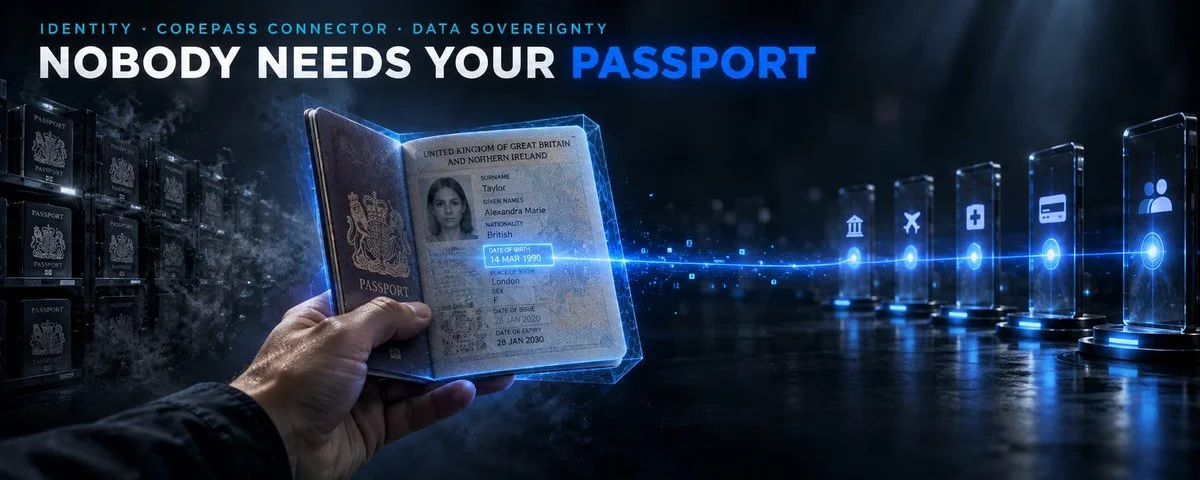
The Connector turns that around. The platform sees which details you have already verified in CorePass and asks for exactly those. The request appears on your phone, and you decide in the app. If a provider only needs your date of birth, it gets your date of birth. Nothing more.
Platforms can request single details from ID cards, passports, residence permits and driver's licences, plus address, email and phone number.
An online shop sells products for adults only. Until now that meant: photograph your ID, upload it, wait. With the Connector, the shop asks for your date of birth and learns exactly that. Your photo, your address and your ID number stay with you.
You get verified once, not again at every service. If something changes, the platform checks whether your details are still valid.
What was never stored cannot be stolen
Anyone who stores ID photos, selfies and passport numbers holds exactly what attackers are looking for. And carries the liability when it disappears.
With CorePass, ID copies and face images never enter the building. A verification partner handles the check once. Your documents sit encrypted on your phone. The platform receives only what it asked for and you approved.
For providers, that is real money. Storing and securing ID copies, contracts with verification vendors, support for forgotten passwords, and in the worst case a data breach with reporting duties and fines: the most expensive and riskiest part of all that disappears. What remains is a handful of details the user chose to release.
Your data, your money
AI fakes images, accounts and even voices. That makes proof of a real person behind a detail worth more every day. Verified identity data is becoming a currency.
Until now, others earned from it: platforms, data brokers and, after every breach, the criminals who resell stolen identities. The person the data belongs to walked away with nothing.
That is over. When a platform requests your data and you release it, you receive Core Token. The Connector handles the settlement. The platform does not have to build anything for it or hold Core Token itself. What is everyday practice on Ping Exchange now applies to every platform with the Connector.
World first: the company becomes a wallet with voting rights
What works for people now works for businesses too. Who is behind an online shop? Who can sign for a company? Today, register extracts, PDFs and endless email threads settle those questions.
CoDeTech built KYB for this, short for "Know Your Business", and goes a step further than anyone else. Register a company in CorePass and it automatically becomes a DAO: an organisation whose rules live on the blockchain. Members with voting rights. For each kind of decision, a fixed rule on whether everyone has to agree or a majority is enough. No single person holds the key, not even CorePass.
Other providers confirm that a company exists. In CorePass, the company itself becomes a wallet: its own account on the blockchain, which its members vote on. Nobody built that before CoDeTech.
Through the Connector, an employee signs in on behalf of their company. Platforms request verified company data, such as the registered name or the directors. Companies sign documents digitally. That is how the documentation describes it.
On 30 September, Ockert Loubser reported: KYB is on the Core mainnet, the main network of the Core Blockchain. The matching CorePass update is with the App Store and Google Play. As soon as both approve it, businesses can get started.
Then both sides can prove who they are: the person who releases the data and the company that requests it.
Products become infrastructure
Every platform with the Connector gives its users a reason to install CorePass and get verified. Every verified user makes the Connector more attractive for the next platform, because they arrive with their confirmed details already in hand. With every platform, a single verification is worth more, for the user and for everyone already connected.
Each of those platforms becomes an entrance to the ecosystem. Whoever reaches their Core ID through an online shop holds the same key they use to sign in to Ping Exchange. The Core Token they receive for their data goes back to work in the ecosystem, for example for further verifications in CorePass or on Ping Exchange. Value created in one place stays in the system.
That is the real step. Until now, Core grew with what CoDeTech built. From now on, it grows with everyone who connects. With KYB, businesses join too, with their teams, their customers and their commerce. A series of products becomes infrastructure.
We already use it
Our internal tools at TMMAC already run behind a CorePass login: a tap on the phone, a QR code on the computer. That is only the start.
What you need to know
You need CorePass. For signing in, the app is enough. To share data, you get the relevant details verified once. After that, a scan is all it takes on every further platform.
You pay for the verification yourself, once and per detail: 0.99 Swiss francs for your email address, 2.99 for proof of address, 14.99 for an identity document. Until now the bank, the exchange or the shop paid, because they got your data in return. Now the result belongs to you.
The platform pays too: it buys packages for its data requests in advance.
Nobody builds in the Connector anonymously. Anyone who wants to use it gets in touch via contact@corepass.net and gets verified with CorePass themselves. Whoever wants to request other people's data proves who they are first. That is exactly how it should be.
Whether the data meets a specific legal obligation is something every platform settles for its own market. For new social media accounts, the KIDS Act proposal foresees a certified EU solution.
Each platform decides which details it requests, up to ID images. You stay in control all the same: you see every request and can decline it.
Now it is about who connects
Digital identity is coming. We will have to identify ourselves, that much is clear. The question is who keeps the copy afterwards.
CoDeTech has built the answer: the Core Blockchain since 2022, and on top of it an identity layer, trading and payments. With the CorePass Connector, any platform connects to it without running anything itself. With KYB, businesses follow. The strength of an ecosystem shows in how many others build on it.
For everyone who signs up anywhere, that means: nobody needs your whole passport anymore. They need one line from it. And you only hand it over if you want to.
The question is no longer what CoDeTech builds next. It is who connects next.
Sources
- EU KIDS Act: helping children navigate a safer online world, European Commission, 17 September 2026.
- European Commission proposes EU KIDS Act, Wilson Sonsini Data Advisor, September 2026.
- EU KIDS Act and age assurance, Bratby Law, on COM(2026) 681, Art. 29(2).
- EUDI wallet deadline nears as Europe's rollout picture remains uneven, Biometric Update, 24 September 2026; Regulation (EU) 2024/1183.
- Discord suffers data breach impacting at least 70,000 users, TechCrunch, 9 October 2025.
- Mainnet is live, Core Blockchain, 6 May 2022.
- CorePass Connector and CorePass developer documentation, Connector v2 (KYC, KYB, deployment).
- CorePass Connector overview, CorePass.
- Connector announcement, CoDeTech on X, 25 September 2026.
- KYB deployed on Core mainnet, Ockert Loubser on X, 30 September 2026.